A sword drawn in a hall of peace
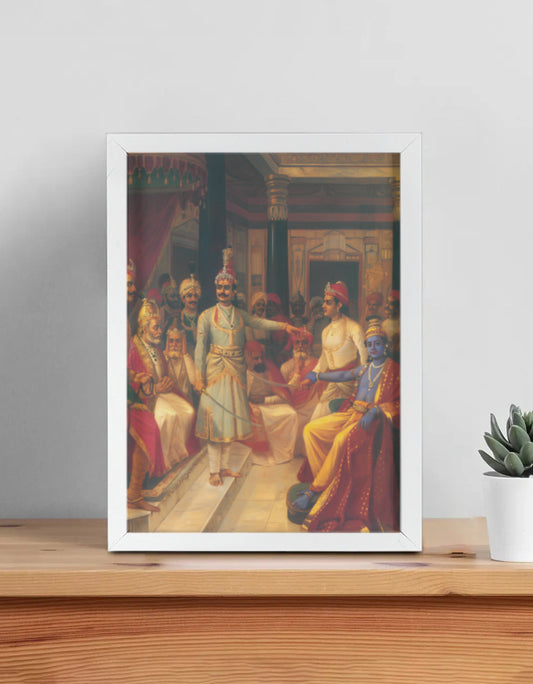
A blue-skinned figure sits at ease in a crowded royal hall, his saffron and red robes pooling around him. Behind him, a young warrior in white has drawn his sword. Krishna does not even turn around. He simply reaches back and takes hold of the young man's wrist.
That one quiet gesture carries the weight of the Mahabharata. Here is the last real chance to stop a war that will destroy a family, and the one person who could win by force chooses not to. Raja Ravi Varma painted this scene for the Maharaja of Mysore in the final two years of his life, and it remains one of his most dramatic epic canvases.
Krishna, the envoy who came for peace
The story comes from the Udyoga Parva, the fifth book of the Mahabharata, when the Pandavas and Kauravas stand on the edge of the Kurukshetra war. Krishna travels to the Kuru capital as the Pandavas' envoy of peace, and his kinsman Satyaki, a Yadava warrior devoted to him, goes with him.
In Kisari Mohan Ganguli's translation, Duryodhana, Karna, Shakuni and Dussasana plot to seize Krishna inside the court, hoping that capturing him will break the Pandavas' spirit. Satyaki, described as able to read the heart by signs, discovers the plan. He tells Kritavarman to array the troops at the court's entrance, then warns Krishna, King Dhritarashtra and Vidura. The plotters, he laughs, are like children trying to seize a blazing fire with their garments.
Krishna's reply is the key to this painting. He says he could overpower them all, but he will not commit "any sinful and censurable act." Instead he lets them try. In the next chapter he laughs and reveals his cosmic form to the court, and every king closes his eyes in fear, except Drona, Bhishma, Vidura, Sanjaya and the sages. Then Krishna walks out, arm in arm with Satyaki and Kritavarman.
Reading the painting
Krishna at rest
Krishna is the only calm figure in the room. He sits low and relaxed, crowned and jewelled, in a saffron lower garment and a red shawl with a gold border, while almost everyone around him is on their feet. Ravi Varma lets his stillness do the talking. A man who knows the outcome has no need to stand.
The restraining hand
Krishna's left arm stretches back to grip the wrist of the swordsman behind him. It turns the epic's idea into a single, readable action: power that holds itself back.
This arm also carries a famous story. According to a 1941 Kannada biography of Maharaja Krishnaraja Wadiyar IV, cited in a 2022 study by Chandan Kashyap S K, the Maharaja politely pointed out that Krishna's arm looked too long. Ravi Varma is said to have accepted the correction and repainted it within days.
The young man in white
Wikipedia's article on Satyaki identifies the figure in white, drawing his sword, as Satyaki, reacting to Duryodhana's insults. The 1941 biography, as cited in the same study, speaks instead of Krishna holding Arjuna's hand. Sources disagree here. In the epic text we read, it is Satyaki who is in the court with Krishna.
The prince with the sword
Standing near the centre, in pale embroidered silk, a proud prince holds a sword lowered at his side and points across the room. Wikipedia's caption reads the figure on the left as Duryodhana, the host who has turned a diplomatic visit into an ambush.
The watching elders
On the left, grey-bearded elders in crowns and turbans sit and watch, some leaning forward. The epic places Bhishma, Drona, Vidura and Dhritarashtra in this court, but the painting does not label anyone, so we will not guess which face is which.
The hall itself
Behind the figures rise dark green pillars with gilded capitals, a red canopy over the throne at top left, and a carved doorway in the distance. This deep, believable space is Ravi Varma's European academic training at work, used to make an ancient story feel like something happening in front of you.
The artist
Raja Ravi Varma was born on 29 April 1848 at Kilimanoor in the princely state of Travancore, in present-day Kerala. He learnt watercolour from the palace painter Rama Swami Naidu and oil painting from the British portraitist Theodore Jenson. His work won an award at an exhibition in Vienna in 1873, and in 1904 the Viceroy, Lord Curzon, conferred the Kaisar-i-Hind Gold Medal on him.
Ravi Varma is widely recognised for blending European academic painting with Indian subjects and iconography. The art historian Geeta Kapur called him the "indisputable father figure of modern Indian art." He also had critics: the scholar Ratan Parimoo dismissed his work as kitsch.
He reached ordinary homes through prints. His lithographic press began in Bombay, though sources disagree on the date: Wikipedia gives 1894 at Ghatkopar, while a Deccan Herald feature says by 1892 in south Mumbai. It moved near Lonavala in 1899 and was sold to his German technician, Fritz Schleicher, in 1901. The Deccan Herald says that sale included the right to print 89 of his paintings.
He died on 2 October 1906. Wikipedia places his death at Attingal, while the 2022 study, citing a telegram of the time, says Kilimanoor Palace.
The history of this image
In 1904 Ravi Varma travelled to Mysore with his brother, the painter C. Raja Raja Varma. Palace letters studied by Chandan Kashyap S K show the brothers were given carriages, a cook and a music concert, because they wanted to hear Mysore music. Maharaja Krishnaraja Wadiyar IV commissioned a series of nine Puranic paintings for the rear wall of the public durbar hall of the new Amba Vilas palace, then under construction. Ravi Varma quoted Rs 25,000 for the series, and it was accepted.
He painted the series after returning home. The finished canvases left by goods train for Bangalore on 29 October 1905. In January 1906 he came back to Mysore to add finishing touches, and before leaving on 8 February 1906 he saw the paintings on temporary display. A letter of 8 November 1905 says ill health kept him from painting two of the nine subjects.
The palace records list this one as "Krishna's Embassy to Duryodhana". The 1941 Kannada biography calls it "Krishnadautya", Krishna's embassy. According to that biography, the series was shown at the Mysore Dasara exhibition of 1906, just before the artist's death. When the durbar hall was extended in the 1930s, new pillars blocked the old wall, and the paintings were later moved elsewhere.
Why it endured
Ravi Varma's images of the epics became, as Wikipedia puts it, part of how India imagines those stories. His prints went on being produced in thousands long after his death, and the Deccan Herald reports that admirers later bought the rights to print works from the Mysore and Baroda collections.
This scene lasts because its lesson does not age. It shows a moment when war could still have been avoided, and a leader whose strength lies in what he refuses to do. In April 2026, another Krishna painting by Ravi Varma, Yashoda and Krishna, sold for ₹167.2 crore, an auction record for an Indian artist, a sign of how strongly his vision still speaks.
About this print
The original is an oil painting on canvas by Raja Ravi Varma, dated 1905. It was painted for Maharaja Krishnaraja Wadiyar IV of Mysore, with finishing touches added in Mysore in early 1906. It belongs to a series of large canvases. The palace records list seven of the nine subjects at 7 ft 10 in × 5 ft and two at 5 ft 4 in × 4 ft. The sources we read do not say which size this one is.
How we restored it
Our restoration is entirely digital. We cleaned away stains, specks and surface damage, reduced grain, and sharpened fine detail such as the jewellery, the embroidered silks and the carved pillars. We corrected the colour carefully against the source, so Krishna's blue skin and the reds and saffrons of the hall read as the painter intended. Some steps use AI-assisted tools, and every change is checked by eye. Nothing was repainted, and no physical artwork was touched.
Bringing it home
- A living room or study wall that can hold a large, story-rich image
- A pooja room or quiet corner for reflection
- An office or chamber, for anyone whose work is negotiation, law or mediation
- A gift for Janmashtami, Diwali or a housewarming
- A thoughtful present for a lover of the Mahabharata or of Indian art history
Quick facts
- Title: Krishna's Embassy to Duryodhana (also known as Sri Krishna as Envoy; Kannada title Krishnadautya)
- Artist: Raja Ravi Varma (1848–1906)
- Date: 1905, with finishing touches in January 1906
- Medium: Oil on canvas
- Style: Academic art
- Commissioned by: Maharaja Krishnaraja Wadiyar IV of Mysore
- Commission: One of a series of nine Puranic subjects for the durbar hall of the new Mysore palace, quoted at Rs 25,000
- Source text: Mahabharata, Udyoga Parva (Book 5)
- Key figures: Krishna, Satyaki (some accounts say Arjuna), Duryodhana and the Kuru elders




Join the conversation
Comments
What does this painting mean to you?
Log in to join the conversation
No password needed. We email you a one-time code.
Awaiting approval
No comments yet. Be the first to share your thoughts.