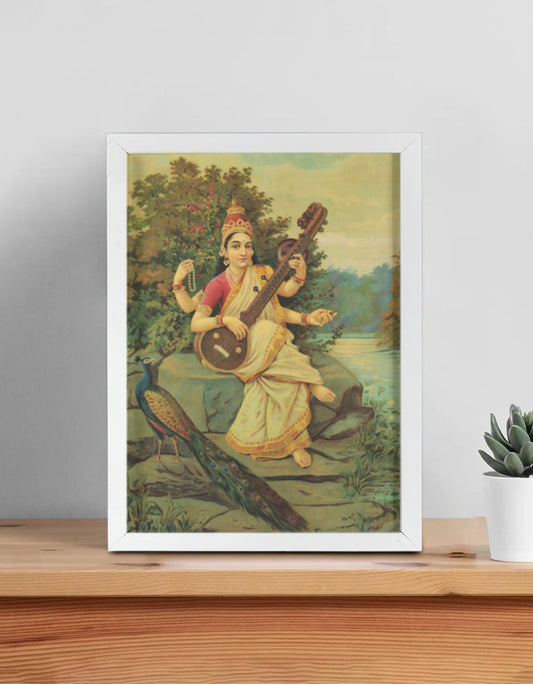
Walk into a school, a music class or a pooja room almost anywhere in India and there is a good chance you will meet her: a calm woman in a white sari, seated beside the water, fingers resting on the strings of a veena, a peacock at her side. For millions of people this is simply what Saraswati looks like. Few know that the image was shaped by one painter, Raja Ravi Varma, in the 1890s, and carried into homes across the country by the printing press he founded.
This is the story of that picture: who Saraswati is, what every detail in the painting means, how a royal artist from Travancore turned a single canvas into one of the most widely recognised religious images in India, and how the print we restored came to survive for nearly a century.
Who is Saraswati?
Saraswati is the Hindu goddess of knowledge, speech, music and the arts. Her name is older than her image. In the Rigveda, Sarasvati is first a great river, praised for her abundant waters, and the goddess never fully leaves that river behind. Learning, in this old way of thinking, flows like water: it nourishes whatever it touches, and it keeps moving.
The Puranas give her a fuller story. The Brahma Purana describes her as born from Brahma, the creator, and gives her duties that read almost like a job description for a goddess of learning: to live on the tongues of the learned, and to flow on earth as a river. Other texts settle how she should look. The Agni Purana describes her dressed in white, playing the veena, and holding a rosary (akshamala) and a book (pustaka). Those four details, white cloth, veena, rosary and book, are exactly the ones Ravi Varma chose to paint.
Every year on Basant Panchami, at the start of spring, students place their books and pens before her image and musicians bring their instruments, asking for clarity of mind and the gift of expression. For many families, the image they bow to on that day is a descendant of this painting.
Reading the painting
Ravi Varma packed the canvas with symbols, but he arranged them so naturally that the picture reads first as a portrait of a real woman at rest by a river. Look closer and each element carries a meaning.
The white sari
White is Saraswati's colour. It stands for purity, clarity and the calm, balanced state of mind that Indian philosophy calls sattva. Ravi Varma dresses her in a white sari edged with gold, so she looks both simple and regal, a scholar rather than a queen.
The veena
The veena is the oldest and most important of her attributes. It stands for music and, beyond music, for every art that needs both discipline and feeling. She does not hold it as an ornament; she plays it, which tells you that knowledge here is something practised, not just possessed.
The book and the rosary
The palm-leaf manuscript is learning in its written form: the Vedas, the sciences, everything that can be studied. The rosary is learning in its inward form: concentration, repetition and meditation. Together they say that real knowledge needs both study and stillness.
The peacock, and the missing swan
In much of Indian art Saraswati rides a swan (hamsa), a bird said to be able to separate milk from water, just as wisdom separates truth from falsehood. Ravi Varma instead placed a peacock beside her. The earliest texts give Saraswati no vehicle at all, and later traditions name either the swan or the peacock. The peacock, with its spectacular display, is often read as the beauty and pride that true learning must keep in check. Whatever Ravi Varma intended, it is one of the details that makes his Saraswati instantly recognisable.
The water and the lotus
She sits on a rock at the water's edge, with lotuses in the river around her. The setting quietly returns her to her oldest identity, the river goddess of the Rigveda. The lotus, which rises clean from muddy water, is a familiar Indian symbol of a mind that stays pure in the world.
Raja Ravi Varma: the painter who gave the gods a human face
Raja Ravi Varma was born on 29 April 1848 at Kilimanoor palace in the princely state of Travancore, in present-day Kerala. He learned watercolour from Rama Swami Naidu and, by many accounts reluctantly, the techniques of oil painting from the British portrait painter Theodore Jenson. Oil paint, still unusual for Indian artists of his day, let him model skin, cloth and light with a realism that was new to Indian religious painting.
He became famous fast. His paintings won an award at an exhibition in Vienna in 1873, and three gold medals at the World's Columbian Exposition in Chicago in 1893. In 1904 the Viceroy, Lord Curzon, awarded him the Kaisar-i-Hind Gold Medal. He painted the royal families of India, but the work that made him a household name was something new: scenes from the Ramayana, the Mahabharata and the Puranas, painted in the realistic European academic style but filled with Indian faces, clothes, jewellery and landscapes.
Before Ravi Varma, most images of gods and goddesses followed temple conventions: many arms, stylised faces, symbolic colours. He painted them as people you could imagine meeting. Saraswati is a perfect example. She is unmistakably divine, yet she could be a real woman sitting by a real river.
From one canvas to millions of homes: the Ravi Varma Press
Paintings in palaces could only reach a few people. In 1894, reportedly on the advice of Sir T. Madhava Rao, a former Dewan of Travancore, Ravi Varma set up a printing press at Ghatkopar in Bombay (now Mumbai) to reproduce his paintings as colour prints. The press used chromolithography, a technique in which each colour is printed from its own carefully prepared stone, one layer at a time, to build up a full-colour picture. Prints like these, often varnished or embossed to look like oil paintings, are also called oleographs.
The result was revolutionary. For the first time, ordinary families could afford a richly coloured image of a goddess for their own walls. Early Saraswati prints from the press, dated between 1894 and 1900, show finely graded colours and a naturalism that reflects the influence of Victorian-era art.
In 1899 the press moved to Malavli, near Lonavala, in the hills between Bombay and Pune. The business struggled with debt, and in 1901 Ravi Varma sold it to Fritz Schleicher, his German printing technician. Schleicher kept printing Ravi Varma's images, and they went on selling in their thousands for decades after the painter's death on 2 October 1906. A fire destroyed the factory in 1972, and many of the original prints were lost with it.
Not everyone celebrated this success. Some critics, among them the art historian Ratan Parimoo, blamed Ravi Varma's glossy realism for the "vulgarity" of later popular art, comparing it to calendar pictures and films. Yet even his critics do not dispute the scale of his influence. Through his press, Ravi Varma shaped how a whole country pictured its gods.
Why this image endured
Many artists have painted Saraswati, but this is the version that stuck. It is often described as the most common and popular image of Saraswati, and there are good reasons for that.
The composition is calm and easy to read even from across a room. The symbols follow the old texts closely, so the image felt "correct" to devout viewers, while the realism made it feel close and personal. And because it was printed again and again for decades, it became the picture people grew up with. Look at the Saraswati images in classrooms, on book covers and in festival decorations today and you will often see echoes of Ravi Varma's composition: the white sari, the veena held across the body, the peacock and the river.
About this print
The print we restored was produced by the Ravi Varma Press at Malavli, Lonavala, around 1930, almost three decades after Ravi Varma sold the press and long after his death, when it was still printing his designs. It is a chromolithograph on paper measuring about 70 × 50 cm.
The original painting was made by Ravi Varma in the 1890s; the press reproduced it many times over the following decades, which is why prints of this Saraswati survive in collections around the world.
How we restored it
Prints from this period have usually lived hard lives: hung in humid rooms, exposed to sunlight and handled for decades. Our starting point showed the familiar signs of age, from faded colour and stains to specks of dust and paper damage.
We restored the image digitally. We cleaned the stains, specks and paper damage, reduced the grain left by age and printing, sharpened fine details such as the jewellery, the veena strings and the peacock's feathers, and corrected the colours against the original print. Some of this work used AI-assisted restoration tools, always checked by eye against the source. We did not repaint, recompose or "improve" Ravi Varma's design. The aim was simply to let you see the picture as close as possible to how it looked when it first came off the press.
Bringing Saraswati home
Saraswati belongs wherever learning and creativity happen. She is a natural fit for:
- a study or a child's room, as a daily reminder of focus and curiosity;
- a music room or practice corner, where the veena speaks for itself;
- a pooja room, especially for Basant Panchami and Saraswati Puja;
- a home office, library or reading nook.
She also makes a thoughtful gift for students before exams, for teachers, for musicians and artists, and for housewarmings. Our prints come as framed posters in black or white frames and as ready-to-hang canvas, all printed to order and delivered free across India.
Quick facts
- Title: Saraswati
- Artist: Raja Ravi Varma (1848–1906)
- Original painting: 1890s
- This print: Chromolithograph on paper, Ravi Varma Press, Malavli, Lonavala, around 1930
- Size of the print: about 70 × 50 cm
- Subject: Saraswati, goddess of knowledge, music and the arts
- Symbols: white sari, veena, palm-leaf book, rosary, peacock, lotus and river




Join the conversation
Comments
What does this painting mean to you?
Log in to join the conversation
No password needed. We email you a one-time code.
Awaiting approval
No comments yet. Be the first to share your thoughts.