The ocean that would not answer
For three nights Rama lay on a bed of sacred grass at the edge of the sea, his own arm for a pillow, waiting for the ocean to appear. Sita was a prisoner across the water in Lanka. An army of monkeys waited behind him. And the ocean would not even show its face.
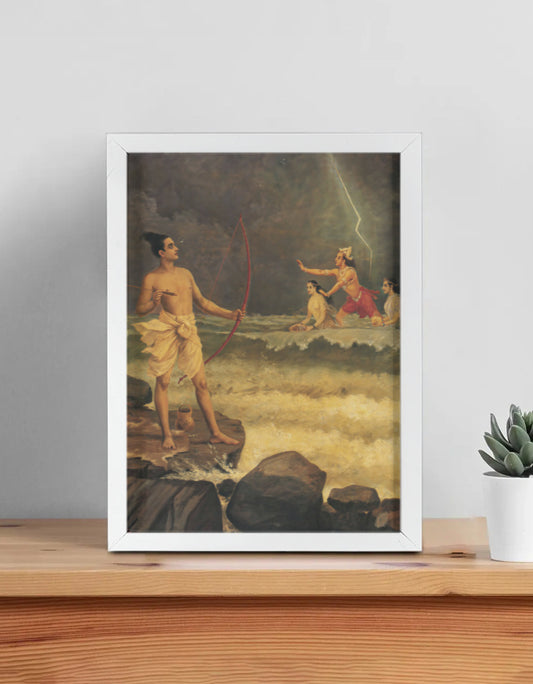
Raja Ravi Varma painted the moment the waiting ends. Rama stands on a rock above a heaving sea, bow in hand and anger in every line of him, while the lord of the waters rises with his companions to plead for calm. Ravi Varma made it in 1905 for the Maharaja of Mysore, in a season of private grief, near the end of his own life.
The story behind the scene
The episode comes from the Yuddha Kanda, the book of war in Valmiki's Ramayana. Ravana has carried Sita off to Lanka, and Rama has marched south with his brother Lakshmana and the monkey army. Between them and Lanka lies the sea.
Rama does everything correctly. He spreads darbha grass on the shore, faces east with joined palms and lies down in silence, having sworn, in K. M. K. Murthy's translation, "Either crossing of the ocean or a death should occur to me today."
Three nights pass, and the ocean does not appear. The corners of Rama's eyes turn red. Patience and gentle words, he tells Lakshmana, achieve nothing with those who have no virtue; the ocean has mistaken his forbearance for weakness. His arrows tear into the water until the sea heaves and its serpents and crocodiles are thrown into terror. Lakshmana seizes the bow and begs him to stop.
In the next chapter Rama fits an arrow charged with the power of Brahma. Heaven and earth seem to split, darkness falls, lightning flashes and thunder rolls. Only then does the ocean god rise from the deep, gleaming like emerald set in gold, wreathed in pearls and flowers, escorted by rivers led by the Ganga and the Sindhu. He comes with joined palms.
His answer is humble but firm: every element keeps to its own nature, and his is to be fathomless. "It becomes unnatural if I am shallow," he says in Murthy's translation. Instead he offers to bear a bridge, built by Nala, son of the divine architect Vishvakarma. In five days the bridge is done, and the army crosses to Lanka.
Varuna or the Ocean?
The painting's title names the sea god Varuna, but Valmiki calls him Sagara, the Ocean, and Wikipedia notes that most accounts make Rama's opponent the ocean god rather than Varuna. The two have long been linked. Britannica describes Varuna as the Vedic upholder of cosmic and moral law who, in later Hinduism, became guardian of the west and was linked above all with oceans and waters.
Reading the painting
The conservator and Ravi Varma scholar Rupika Chawla places this among the works the artist called Puranic: large canvases with several figures frozen mid-action, at a moment that sets off everything after it. This one, she says, announces the war with Ravana still to come.
Rama on the rock
Rama is the main figure, set on a rock in the foreground. Chawla points to the flared nostrils and flaming eyes Ravi Varma gave him, an echo of Valmiki's red-cornered eyes.
The bow
Rama grips his bow and arrow, poised to release their power. In the story this is the Brahma weapon, the threat in the painting's title, and the only thing that finally brings the ocean to the surface.
The god who pleads
Three figures rise from the water: Varuna, flanked by his consorts, pleading with Rama. One account reads his gesture as submission. In Valmiki the ocean comes escorted by rivers, and Britannica notes that Varuna is often attended by river goddesses.
Storm, wave and wind
The sky is dark and stormy, split by a bolt of lightning. Violent waves churn into white froth, and Rama's clothes stream in the wind, all echoing Valmiki's darkness and thunder.
A diagonal of tension
The composition runs on a diagonal, with Rama balanced against the turbulent waves. Light and shadow and detailed brushwork carry the drama, in what one study guide calls warm, muted browns, yellows and oranges.
The artist
Raja Ravi Varma was born on 29 April 1848 at Kilimanoor in Travancore, in present-day Kerala. He learned watercolour from Rama Swami Naidu and, rather reluctantly, oil painting from the British portraitist Theodore Jenson.
He won an award at Vienna in 1873, sent works to the Chicago exposition of 1893, and in 1904 received the Kaisar-i-Hind Gold Medal from Lord Curzon. In 1888 the Gaekwad of Baroda commissioned fourteen Puranic paintings from him. His younger brother, C. Raja Raja Varma, worked beside him all his life, painting the backdrops and landscapes of his epic scenes.
In 1894 the brothers opened a lithographic press in Ghatkopar, Bombay. It moved to Malavli near Lonavala in 1899 and was sold in 1901 to its German technician, Fritz Schleicher, but its prints carried Ravi Varma's gods into ordinary homes.
Critics have never agreed on him. The art historian Ratan Parimoo dismissed his work as kitsch; the critic Geeta Kapur called him "the indisputable father figure of modern Indian art." He died on 2 October 1906, at Attingal or Kilimanoor Palace; sources differ.
The history of this painting
A commission for a new palace
Ravi Varma first visited the Mysore court in the late 1880s. In 1904 he returned at the invitation of Maharaja Krishnaraja Wadiyar IV, whose new Amba Vilas Palace was under construction, according to palace letters studied by Chandan Kashyap S K in The Chitrolekha Journal on Art and Design.
The brothers were welcomed with carriages and a concert of Mysore music, and shown the spaces set aside on the wall of the public durbar hall. Ravi Varma quoted Rs 25,000 for nine Puranic paintings, recalling that Baroda had paid him Rs 1,500 for each smaller canvas. The price was accepted.
Painted through grief
After sketching in Mysore, Ravi Varma went home to paint. Before the series was finished, Raja Raja Varma died. Chawla dates the loss to January 1905; Madras Musings places it in Mysore in 1904. Ravi Varma, already diabetic, kept working.
On 29 October 1905 he sent the canvases to Bangalore by goods train in two parcels. A letter that November admits ill health had kept him from painting two of the nine. In January 1906 he returned to Mysore to give them their finishing touches, in time for the visit of the Prince of Wales.
According to a 1941 Kannada biography of the Maharaja, the series was shown at the Mysore Dasara exhibition of 1906. The artist was too ill to attend, and died that October.
A Kannada name and a moved wall
The same biography places this canvas on the durbar hall's western wall under the title Samudrajagarvabhanga. When the hall was extended in the 1930s, new pillars all but hid that wall, and the series came down. Goddess paintings by Siddhalinga Swami now fill the niches, and many visitors assume they are Ravi Varma's.
One question stays open. A 2020 Onmanorama report describes a Kochi family's old lithograph of "Sri Rama vanquishing the ocean" as taken from an original in the Baroda palace, while the Mysore records list this subject among the 1904 commissions. The sources we read do not settle the difference.
Why it endured
The press Ravi Varma founded kept printing his epic scenes in their thousands for years after his death, and his way of picturing the epic heroes became part of how India imagines them.
The painting is still taught. The Central Board of Secondary Education's Class XII painting marking scheme for 2026–27 asks students to appreciate it as Rama Vanquishing the Pride of the Ocean, from its diagonal composition to its stormy sky. His market keeps rising, too: in April 2026 his Yashoda and Krishna sold for ₹167.2 crore, an auction record for an Indian artist.
And the story asks a question that never ages: when does patience stop being a virtue? Rama's anger and the ocean's dignified reply meet on one canvas, and neither wins outright. A bridge does.
About this print
The original is an oil painting on canvas by Raja Ravi Varma, dated 1905, one of the Puranic canvases commissioned by Maharaja Krishnaraja Wadiyar IV of Mysore for the public durbar hall of the Amba Vilas Palace.
Palace records list seven canvases in the series at 7 ft 10 in × 5 ft and two at 5 ft 4 in × 4 ft; the sources we read do not say which size this one is. Our print reproduces the painting itself, restored digitally.
How we restored it
Our restoration is entirely digital. We never touched the canvas, and nothing was repainted or physically conserved.
We cleaned away stains, specks and signs of damage, reduced grain, and sharpened detail in the faces, the drapery and the breaking waves. We corrected colour against the source so the storm stays dark and the skin tones stay true. Some steps used AI-assisted tools, and every change was checked by eye.
Bringing it home
- A living room wall that can hold a large, dramatic picture
- A study or office, as a daily reminder of patience and resolve
- A prayer corner or puja room
- Ram Navami, Dussehra or Diwali gifts
- Housewarmings and new beginnings
- Anyone who loves the sea
Quick facts
- Title: Rama Threatens the Ocean God Varuna on His Not Making Way for Him
- Also known as: Sri Rama Sagar Darpa Haran; Rama Vanquishing the Pride of the Ocean; Lord Rama Conquers Varuna; Samudrajagarvabhanga (Kannada)
- Artist: Raja Ravi Varma (1848–1906)
- Date: 1905
- Medium: Oil on canvas
- Style: Academic art
- Commissioned by: Maharaja Krishnaraja Wadiyar IV of Mysore
- Made for: The public durbar hall of the Amba Vilas Palace, Mysore
- Series: One of nine Puranic subjects commissioned in 1904; the artist completed seven
- Fee for the series: Rs 25,000
- Source text: Valmiki Ramayana, Yuddha Kanda, sargas 21–22




Join the conversation
Comments
What does this painting mean to you?
Log in to join the conversation
No password needed. We email you a one-time code.
Awaiting approval
No comments yet. Be the first to share your thoughts.