A feast that never spoils
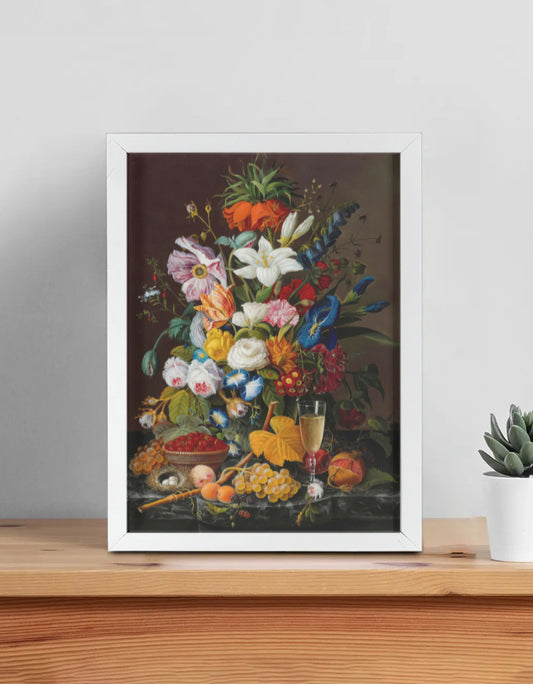
Lean in close and the petals still seem wet. Morning glories, roses and tulips crowd in with ripe fruit and a slender glass of sparkling wine, all resting on a dark marble ledge. Nothing here wilts, nothing gets eaten, and nothing will ever be cleared away.
The man who painted this plenty had reached New York only a few years earlier, a porcelain painter from Prussia with a gift for flowers. He is now recognised as one of the major still-life painters of nineteenth-century America. Yet he vanished so completely that no one knows where, or even when, he died.
What the painting shows
Victorian Bouquet is a still life, a picture of things rather than people, and its true subject is abundance. Flowers spill in every direction: morning glories, roses, irises, tulips, dahlias, poppies and foxgloves among them. Around them lie blackberries, apricots and strawberries. A bird's nest holding eggs is tucked into the arrangement, and a thin-stemmed glass of sparkling wine keeps the fruit company.
Roesen painted it in New York in the early 1850s, within a few years of stepping off the boat. Writers on the picture read it as a celebration of mid-nineteenth-century America's wealth and good fortune, the fruit of fast-growing cities and new industry.
Reading the painting
A bouquet no garden could grow
Look again and you will notice these flowers could never have bloomed together, because they flower at different times of the year. That is an old trick of the Dutch flower painters. Jan van Huysum (1682–1749), one of the Dutch masters from whom Roesen's compositions descend, worked from fresh blooms and sometimes waited a year or more for a flower to come back into season before he could finish.
Roesen worked more like an editor. Almost every element in his pictures reappears in others, rearranged and reassembled. Scholars think he built his arrangements partly from real objects and partly from stock designs, and some suggest the botanical prints of his day helped too.
The dark marble ledge
Everything rests on a slab of dark marble. It was one of Roesen's favourite stages; many of his still lifes pile fruit and flowers high on a marble top. Against that cool, dark stone, the soft petals and ripe berries stand out brightly, the effect his lush, richly coloured pictures are known for.
The glass of sparkling wine
A glass is almost always a guest at Roesen's table. In other paintings it is a tall pilsner glass, sometimes beside an open bottle of champagne, or a goblet of lemonade, and it nearly always sits near the lower left edge. Here it is a delicate, thin-stemmed glass of sparkling wine, a note of celebration among the fruit.
Williamsport lore adds a wink. An 1895 newspaper recalled that Roesen would slip the faint outline of a beer glass into a corner of each finished picture. If a customer objected, he would ask, "Why, do you not like beer?" and then paint it out.
The bird's nest
Look for the small nest with its eggs. Nests became something of a Roesen trademark, and a local newspaper notes that they make many of his paintings easy to spot. None of the sources we read record Roesen explaining what the nest meant to him, so its meaning is left to you.
Dewdrops and reflections
Roesen lavished attention on the tiniest things: the edge of a petal, glistening drops of dew, the reflections in the glass. That care may reach back to his first trade. In Germany he painted porcelain, where floral decoration was common, before turning to still lifes in oil. The Dutch tradition behind his work prized the same effects; critics said you could see water drops and crawling ants in van Huysum's flower pieces without a magnifying glass.
A language of flowers
In the nineteenth century, England, North America and France fell for floriography, the language of flowers, in which each bloom carried a message; a deep red rose, for instance, stood for romantic love. But the flower dictionaries never fully agreed, and many blooms had several meanings. Nothing in our sources suggests Roesen coded his bouquets, so enjoy the conversation without treating any one reading as settled.
The artist
The records of Severin Roesen's life are thin, and they do not always agree. A baptism record places him in Boppard, Prussia, where he was baptised on 5 February 1816; some older accounts say he was probably born near Cologne. By 1847 he was a porcelain painter in Cologne. That year he showed a floral painting at the city's local art club and married Sophia Jacobina Lambricht.
The couple reached New York on 4 February 1848, at a time of political turmoil in Germany. Sophia died soon afterwards, and in October 1849 Roesen married Wilhelmine Ludwig. He supported the family by selling paintings to private buyers and to the American Art-Union, and by teaching still-life painting.
In 1857 he left his wife and children and went to Pennsylvania, though New York directories kept listing his address until 1858. After spells in Philadelphia, Harrisburg and Huntingdon, he settled in Williamsport, a booming lumber town. Even that date is disputed: his biographer Judith Hansen O'Toole gives 1860, while other accounts say 1862 or about 1863.
Williamsport suited him. Prosperous merchants and lumbermen, many of German descent, bought his pictures for their new homes and for taverns, restaurants and hotels. One hotelier and brewer, Jacob Flock, owned more than fifty, which Roesen appears to have traded for lodging and beer. The same 1895 newspaper remembered his studio as busy with friends who sat all day with the genial, well-read painter, his pipes and his beer.
Then, after his last dated painting in 1872, the trail goes cold. Maurice Mook, a professor at Lycoming College, believed Roesen retraced his steps to Philadelphia and died in an almshouse that same year. O'Toole was more cautious: "No record of his death has come to light."
The history of this image
Victorian Bouquet is dated only approximately, to around 1850–1855. That is typical. Roesen rarely dated his work, and only about two dozen of his recorded still lifes carry a date. Even the size of his output is debated: more than three hundred paintings have been recorded, one reference puts the total at 300 to 400, and O'Toole catalogued an estimated 250.
These were his busy New York years, when he placed eleven pictures with the American Art-Union (two of our sources say between 1848 and 1852, another says 1848 to 1850). The Art-Union was an unusual scheme. Members paid five dollars a year and received an engraving, and New York members also got a lottery ticket for the chance to win an original painting. It ran into trouble in 1851, a New York court ruled the lottery illegal in 1852, and its whole collection was auctioned that December.
Roesen liked to reuse what worked. Sometimes he painted near-identical copies; more often he reshuffled the same blooms, glasses and nests into fresh arrangements. A closely related canvas of almost the same size, painted around 1852, was even catalogued under the title Victorian Bouquet in O'Toole's 1992 study of the artist, and has since passed through private hands and the auction room.
This canvas's own early history is a blank. Its traceable story begins only when an unidentified antiques dealer sold it on to a New York gallery.
Why it endured
Roesen's timing was good. Still life had no real American tradition to speak of until the 1850s and 1860s, and he did a great deal to make it popular. His crowded tables suited Victorian taste, which loved a surface filled edge to edge, and his accurate flowers matched the period's fascination with science and botany.
His reputation also enjoyed a second life. In February 1962, a newspaper reported that two of his early-1850s pictures, Still Life With Fruit and Nature's Bounty, were among paintings given to the White House for Jacqueline Kennedy's refurbishment. One gallery account says she bought them instead; either way, the attention helped the country appreciate him afresh.
His influence ran deeper than fame. O'Toole argued that, directly and indirectly, Roesen the teacher shaped the many American painters who turned to still life later in the nineteenth century. And in Williamsport, where his name appears in city directories of 1866 and 1872, many of his paintings can still be found today.
About this print
This print reproduces Victorian Bouquet by Severin Roesen, an oil painting on canvas made in New York around 1850–1855. The original canvas measures 91.8 × 73.7 cm (36⅛ × 29 in), a generous size for such a crowded, detailed arrangement.
How we restored it
Our restoration is entirely digital. On screen, we cleaned away stains, specks and surface damage, reduced grain, and sharpened fine detail such as petal edges, dewdrops and the reflections in the glass. We then corrected the colour against the source so the flowers and fruit sit as close to the painting as we can bring them. Some steps use AI-assisted tools, and every change was checked by eye. Nothing was repainted, and the original painting was never touched.
Bringing it home
- Dining room: fruit, flowers and wine feel right where meals are shared, much as Roesen's pictures once hung in homes, taverns and hotels.
- Living room: a burst of colour that rewards a second and third look.
- Entrance or hallway: a warm, generous welcome for guests.
- Housewarming: a wish for a home that is always full.
- Weddings and anniversaries: a bouquet that never fades.
- For a gardener or flower lover: a whole year of blooms in one frame.
- Festive gifting: abundance and celebration, ready to hang.
Quick facts
- Title: Victorian Bouquet
- Artist: Severin Roesen (c. 1815–c. 1872), born in Prussia, active in the United States
- Date: c. 1850–1855
- Painted in: New York
- Medium: Oil on canvas
- Size of original: 91.8 × 73.7 cm (36⅛ × 29 in)
- Style: Realism, rooted in the Dutch still-life tradition
- Subjects: Still life, botanical
- Flowers include: Morning glories, roses, irises, tulips, dahlias, poppies, foxgloves
- Fruits include: Blackberries, apricots, strawberries
- Look for: A bird's nest with eggs and a thin-stemmed glass of sparkling wine




Join the conversation
Comments
What does this painting mean to you?
Log in to join the conversation
No password needed. We email you a one-time code.
Awaiting approval
No comments yet. Be the first to share your thoughts.