A sky that will not keep still
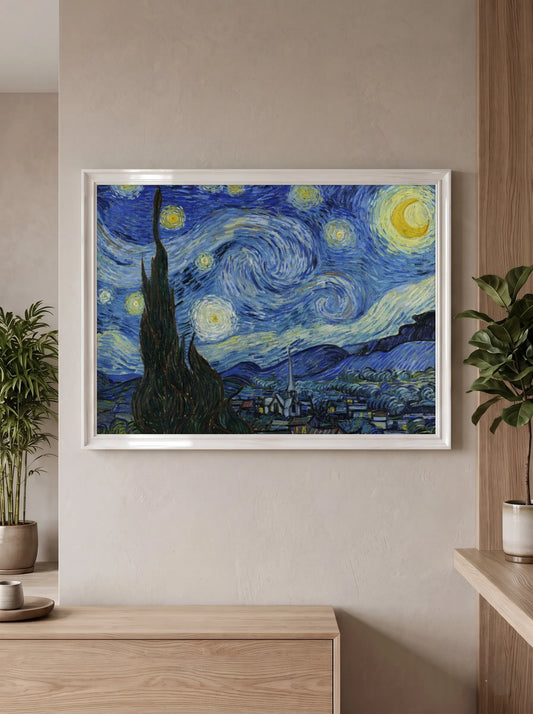
Look at The Starry Night for a moment and the sky begins to move. Long, looping brushstrokes roll across it, the stars pulse inside rings of light, and a crescent moon glows among them. Below, a small village sleeps in a valley, its church steeple just breaking the line of the hills. In front of it all rises a dark cypress, so close to us that the canvas cuts off its base.
Vincent van Gogh painted it in 1889, a few weeks after entering an asylum in the south of France. He wrote hundreds of letters, yet said very little about this picture, and most of what he said was doubt. He even called it a failure. Today it is one of the most recognised paintings in the world.
The view from a barred window
On 23 December 1888, in Arles, Van Gogh suffered a breakdown during which he cut off part of his left ear with a razor. Months between hospital and home followed. On 8 May 1889 he voluntarily entered Saint-Paul-de-Mausole, an asylum in a former monastery near Saint-Rémy-de-Provence.
The asylum was less than half full, so he was given an upstairs bedroom and a ground-floor room to use as a studio. His bedroom window faced east, over a walled wheat field towards the low hills of the Alpilles. He painted that view again and again: at sunrise, under cloud, in wind, in rain. The Starry Night is the only night scene in the series.
He was not allowed to paint in his bedroom, though he could sketch there, so the canvas was worked by day in the studio. How much of it he actually saw is still debated. Some writers say he painted from memory, imagination and perhaps drawings; others point out that the hills, the sky and even the stars match the real view from his window.
Reading the painting
The rolling sky
The sky fills almost three-quarters of the canvas, and nothing in it is still. Its great central swirl has been read in very different ways. The art historian Albert Boime believed Van Gogh must have known the popular astronomy books of Camille Flammarion, which showed spiral nebulae, and saw a galaxy or a comet in it. The Harvard astronomer Charles A. Whitney suggested it might be wind: the mistral, which affected Van Gogh so deeply in Provence. Meyer Schapiro saw a visionary picture inspired by religious feeling.
Van Gogh himself was uneasy. In late November 1889 he told the painter Émile Bernard that he had again been "led astray into reaching for stars that are too big—another failure".
Venus, the morning star
In early June 1889 he wrote to his brother Theo that he had looked out long before sunrise and seen "nothing but the morning star, which looked very big". Boime and Whitney both confirmed that Venus, the morning star, was visible at dawn in Provence that spring and nearly as bright as it ever gets. They identify the brightest "star" in the painting, just to the right of the cypress, as Venus.
The crescent moon
The moon is not a record of the real sky. Astronomical records show it was waning gibbous, more than half full, at the time. Boime thought Van Gogh first painted a fuller moon, then turned it into a traditional crescent, leaving the bright halo as a trace. The art historian Lauren Soth disagreed: to him it is simply a crescent, a shape that meant consolation to Van Gogh.
The cypress
Cypresses have long been linked with death in Europe and are often found in cemeteries, but whether Van Gogh meant that here is an open question. His letters dwell on form: he found cypresses "beautiful in line and proportion like an Egyptian obelisk". Critics still find meaning in the tree. Schapiro saw a vague symbol of human striving; Vojtech Jirat-Wasiutynski, a link between earth and heaven.
Even its presence is argued over. Ronald Pickvance believed no cypresses could be seen from the east-facing window. Boime and Jirat-Wasiutynski said they could, and the biographers Steven Naifeh and Gregory White Smith think Van Gogh simply pulled the distant trees closer.
The village and its steeple
The village is the one element he could not have seen from his room. Naifeh and Smith trace it to a sketch he made from a hillside above Saint-Rémy. Pickvance felt the tall steeple looked more Dutch than Provençal, a memory of churches Van Gogh had painted and drawn years earlier in Nuenen. Either way, steeple and cypress echo each other, both reaching up into the sky.
Blues and yellows
Writing from Arles in September 1888, Van Gogh told his sister Willemien that night could hold even more colour than day. Some stars, he said, looked lemon-yellow, others pink, green or forget-me-not blue, and white dots on blue-black would never be enough. Here he followed his own advice. Analysis of the paint has found ultramarine and cobalt blue in the sky, and the rare pigment Indian yellow, with zinc yellow, in the stars and moon.
The artist
Vincent van Gogh was born on 30 March 1853 in Groot-Zundert, in the southern Netherlands, the eldest surviving child of a Dutch Reformed minister. As a young man he worked for the art dealers Goupil & Cie in The Hague, London and Paris, then tried teaching and preaching, including a spell as a missionary in the coal-mining Borinage district of Belgium.
He took up painting in 1881, supported throughout by his younger brother Theo, who managed an art gallery in Paris. His early work was dark and earthy. His colours brightened in Paris from 1886, and his style came fully into its own in Arles from February 1888. In just over a decade he made about 2,100 works, around 860 of them oil paintings, most in the last two years of his life.
He was not successful in his lifetime. In May 1890 he left the asylum for Auvers-sur-Oise, near Paris. On 27 July he shot himself there, and he died two days later, aged 37.
The history of this image
On or about 18 June 1889, Van Gogh told Theo he had a new study of a starry sky. One account dates the painting slightly later, to late June or early July. That September, listing canvases for Paris, he called it simply a night study and said most of the batch meant little to him. To save postage he first held it back, then sent it on 28 September with nine or ten other paintings.
Theo replied on 22 October with honest criticism: he could see what preoccupied his brother, but felt the search for style was draining the real feeling out of things. Vincent defended that search in his answer, yet by late November he was calling the picture a failure.
Theo died in January 1891, less than six months after Vincent, and his widow, Jo van Gogh-Bonger, became keeper of the paintings and letters. In 1900 she sold The Starry Night to the poet Julien Leclercq, who sold it in 1901 to Gauguin's old friend Émile Schuffenecker. Jo bought it back and in 1906 sold it to the Oldenzeel Gallery in Rotterdam. Georgette P. van Stolk of Rotterdam owned it from 1906 until 1938, when she sold it to the dealer Paul Rosenberg.
In 1941 it entered a public collection. Accounts of that step differ: one describes a purchase from a private collector, another an exchange through Rosenberg for two paintings by Cézanne and one by Toulouse-Lautrec.
Why it endured
When it changed hands in 1941, The Starry Night was not well known. Once on public view and reproduced endlessly, it became one of the most famous images in Western art.
The art historian Noelle Paulson credits its blend of invention, memory and observation, carried by simplified forms, thick paint and boldly contrasting colour, and sees it as a cornerstone of Expressionism. Van Gogh's reputation rose in the early 20th century as the Fauves and German Expressionists took up elements of his style, and as his letters were published in 1914. Irving Stone's 1934 novel Lust for Life, and its 1956 film, spread his fame further, especially in the United States.
Music followed. Don McLean's 1971 song "Vincent", written after he read a biography of the painter, is widely known by its opening words, which echo this painting's title. In 1978 the composer Henri Dutilleux wrote an orchestral work, Timbres, espace, mouvement, inspired by the picture.
Then science joined in. In September 2024 a team of physicists including Yongxiang Huang of Xiamen University reported in the journal Physics of Fluids that the painting's 14 main swirls follow the statistics of real turbulence, matching a law Andrey Kolmogorov would not formulate for another 52 years. At the scale of a single brushstroke they found a second pattern, described by the mathematician George Batchelor.
About this print
The original is an oil painting on canvas by Vincent van Gogh, made at Saint-Rémy-de-Provence in 1889. It measures 73.7 × 92.1 cm, or about 29 × 36¼ inches, and is numbered F612 and JH1731 in the standard catalogues of his work. Our print is a faithful reproduction of that painting, digitally restored and printed for your wall.
How we restored it
We began with a digital image of the painting and worked on it entirely on screen. We cleaned away dust, specks, stains and small marks of damage, reduced grain and noise, and sharpened fine detail so the ridges and twists of Van Gogh's brushstrokes read clearly. We then corrected the colour against the source, so his blues and yellows stay true rather than turning brighter or duller than he painted them.
Some of this work used AI-assisted tools, and every change was checked by eye. Nothing was repainted, and the painting itself was never touched: this is a digital restoration of an image, not physical conservation.
Bringing it home
- Bedroom: a deep blue night sky to end the day with
- Study or reading corner: for dreamers, stargazers and late workers
- Living room: an instantly recognised centrepiece that starts conversations
- Housewarming or griha pravesh: a gift of light for a new home
- Diwali: a festival of lights meets a sky full of them
- Birthdays and graduations: for anyone who loves art, astronomy or science
Quick facts
- Title: The Starry Night
- Artist: Vincent van Gogh (1853–1890), Dutch
- Date: 1889 (by about 18 June, or late June to early July, depending on the source)
- Painted at: Saint-Paul-de-Mausole asylum, near Saint-Rémy-de-Provence, France
- Medium: Oil on canvas
- Size: 73.7 × 92.1 cm (about 29 × 36¼ in)
- Style: Post-Impressionism
- Catalogue numbers: F612, JH1731
- Pigments found: Ultramarine, cobalt blue, Indian yellow, zinc yellow
- The artist's verdict: He called it a failure






Join the conversation
Comments
What does this painting mean to you?
Log in to join the conversation
No password needed. We email you a one-time code.
Awaiting approval
No comments yet. Be the first to share your thoughts.