

The Story Behind the Painting
Flowers in a Blue Vase
Vincent van Gogh·c. June 1887

Some of the yellow flowers in this Van Gogh are no longer the colour he painted them. He made it in Paris around June 1887, teaching himself bold colour with cheap bouquets and borrowed dots, and more than a century later X-ray beams finally explained what went wrong.
- Artist
- Vincent van Gogh
- Date
- c. June 1887
- Medium
- Oil on canvas
- Style
- Oil painting, still life
- Original
- Kröller-Müller Museum, Otterlo
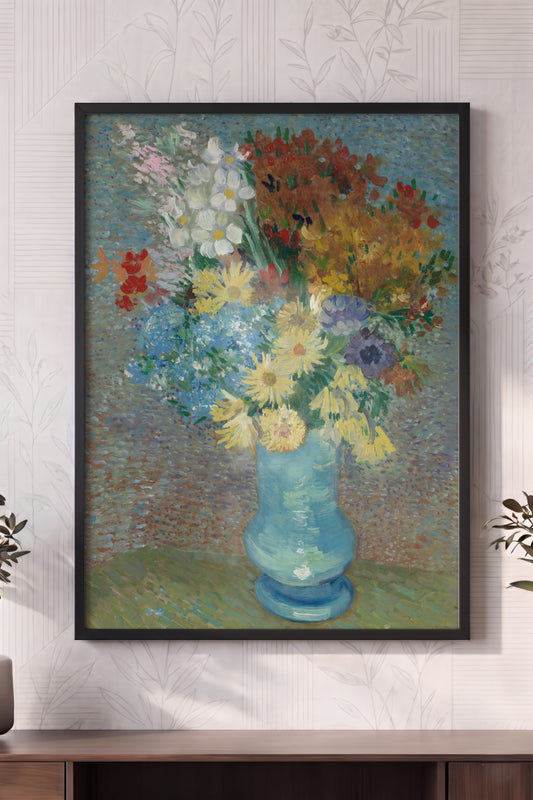
Look at the right side of this bouquet, then let your eye drift up towards the top corner. Some of those blossoms were a clean, strong yellow when Vincent van Gogh painted them in Paris in 1887. Today they have gone a tired orange-grey. For years nobody could say why, and when the answer finally arrived in 2012, it took X-ray beams in France and Germany and two specks of paint smaller than a millimetre.
That is a strange fate for a picture painted to practise colour. In the summer of 1887 Van Gogh was thirty-four, living on his younger brother's money in a Montmartre flat, selling next to nothing and working hard to get the muddy browns of his Dutch years out of his system. A bunch of flowers, a light blue vase and a tabletop were his training ground. He painted the table green, covered the wall behind it in dots, and started on the petals.
A bouquet instead of a model
Van Gogh arrived in Paris early in 1886, at the very end of February by one account and in March by another. He turned up unannounced, sooner than the two brothers had discussed. Theo van Gogh worked for the art dealers Boussod, Valadon & Cie, and he would pay Vincent's way for the rest of the painter's life.
What Vincent really wanted was to paint people. People cost money, though. Models had to be paid, and he had nothing to spare. So he settled on sitters that never asked for a franc.
He explained it himself in a letter written in English to Horace Mann Livens, an English painter he had met at the art academy in Antwerp. Writing in the second half of 1886, he said he had lacked money for models and had made a run of colour studies of flowers instead, among them red poppies, blue cornflowers, forget-me-nots, white and pink roses and yellow chrysanthemums. He was chasing clashes, blue against orange, red against green, yellow against violet. He was, in his own words, "trying to render intense colour and not a grey harmony."
The flowers arrived from all directions. Friends and acquaintances who knew what he was up to sent him bouquets every week, and he bought cheap bunches too, picking a mix of kinds and colours. Anyone who has bargained over a few rupees' worth of marigolds outside a temple will recognise the strategy. He was not shopping for the finest roses in Paris. He was shopping for range.
Flowers even paid for dinner. Van Gogh had an arrangement with Agostina Segatori, who ran the Café du Tambourin on the boulevard de Clichy and whom he courted for a while, trading a few paintings a week for meals. Before long the café's walls were crowded with his flower pictures.
At home, Theo noticed a change. In the summer of 1886 he wrote to their mother that Vincent was painting mostly flowers, to bring livelier colour into the pictures that would follow, and that he was more cheerful than before and people liked him. This was a family whose father had once suggested sending Vincent to an asylum, so it was a rare piece of good news.
That first summer produced about thirty-five flower still lifes. A still life, by the way, is just a painting of things that stay put, such as fruit, pots, books or cut flowers. So where does a bouquet from June 1887 fit in?
Here the sources part company. One detailed description of this canvas says Van Gogh painted at least thirty floral still lifes in the summer of 1887. Most writers put the great flower summer a year earlier, and Van Gogh seems to side with them. In late October 1887 he told his sister Wil, "Last year I painted almost nothing but flowers," and said he had done it to get used to colours other than grey. By June 1887, then, flowers were familiar ground, and he came back to them carrying new tools.
Daisies, anemones and an argument about lilies
What is in the vase depends on who is looking. One close description lists white daisies, yellow sunflowers, blue lilacs, bright red anemones and some dark red blooms that might be lilies, with a cautious question mark after the lilies. The art historian Debra Mancoff, writing about Van Gogh's flowers, sees a lively mix of daisies and anemones, and the painting is also catalogued as Vase with Daisies and Anemones.
The argument matters less than it seems. Van Gogh called these pictures colour studies, and the flowers were there mainly to carry colour, with a dark red-brown lifted by yellows, pinks and whites, all crowded into one tall bunch.
If those yellow heads really are sunflowers, they are early ones. Later that same summer he painted four still lifes of cut sunflowers lying on their sides, the first of the two sunflower series that would end up tied to his name.
Reading Flowers in a Blue Vase, from the table up
The set-up could hardly be plainer. A vase stands on a table in front of a wall, and that is all. Nobody looks out at you, nothing happens, there is no story to follow. Everything interesting is in the paint, so the best way to read this canvas is slowly, one zone at a time, starting at the bottom.
A table the colour of new leaves
The tabletop is laid in with broad, confident strokes of yellow-green, looser and wider than anything above it. Real tables are rarely that colour, which is exactly why it is there. Set beside green, the red anemones in the bouquet look redder.
Van Gogh had done his homework on this. Back in the Netherlands in 1884, he had read the French writer Charles Blanc, whose colour wheel put complementary colours opposite each other, pairing yellow with purple, red with green and blue with orange. Complementary colours are simply pairs that make each other look stronger when they sit side by side. He took the idea so seriously that he kept little balls of coloured yarn, twisting strands together to test combinations for his paintings. The box of yarn still survives.
A blue vase against a blue wall
Now the vase, a light and shiny blue standing in front of a wall that is also blue. On paper that sounds like a styling mistake, rather like wearing a navy kurta to pose against a navy wall. It works because the two blues are pitched differently. The vase is paler and glossier, the wall deeper and broken into dots, so the vase seems to float forward.
Blue also earns its place for the flowers' sake. Van Gogh treated blue and yellow as sparring partners, and one of his cut sunflower canvases from later that summer is built on exactly that pair. Put this bouquet in a brown jug and half its warmth would drain away.
There is a small coincidence here for art detectives. Adolphe Monticelli, the older painter Van Gogh admired so greatly in these years, had painted his own Flowers in a Blue Vase a few years earlier, sometime between 1879 and 1883.
Dots on the wall
Look at the background. It is not painted flat. It is built from small dabs and dots of blue that slide into grey and purple near the bottom of the canvas. This is pointillism, a way of making a picture from many tiny dots of colour that mix in your eye when you step back, instead of being mixed on the palette.
The method came from Georges Seurat and Paul Signac, the leading names of what came to be called Neo-Impressionism. In 1886 two large exhibitions put their dotted pictures in front of the Paris art world, and Van Gogh, slowly at first, paid attention.
He never became a strict pointillist. He could not match Seurat's precision, and he was no purist about the rules. Here the dots stay in the background like a patterned curtain, while the bouquet is painted in a completely different way. The darker grey and purple at the foot of the wall gives the vase something solid to stand against, and purple, remember, is yellow's partner on Blanc's wheel.
Thick paint on the petals
Up in the bouquet the paint gets heavier. Painters call this impasto, paint laid on so thickly that it rises off the canvas and catches the light. The flowers carry far denser paint than the table, which is brushed in broadly, and the wall is different again. Three kinds of mark sit within a few centimetres of each other, like a cook using three different knives on one onion.
Much of that thickness came from Monticelli. Van Gogh discovered the Marseille painter's work in Paris in 1886 and loved his heavy surfaces, where flowers seem to glitter out of the paint like gems. In 1888 Van Gogh described his own method as having no system of brushwork at all, just irregular strokes thrown at the canvas and left as they landed. In this bouquet you can watch that habit forming.
The yellows that changed
Finally, go back to where you started, the right side and upper right of the bouquet. Those orange-grey patches are not shadows, and they are not Van Gogh's choice. They are a thin crust that formed over bright cadmium yellow in the decades after he died. How it got there is a small detective story of its own, and it comes a little further down.
The man with paint on his sleeves
Vincent Willem van Gogh was born on 30 March 1853 in Zundert, a village in the south of the Netherlands, the eldest surviving child of a Protestant minister. He came to painting late and by a long detour. He sold art for the dealers Goupil & Cie in The Hague, London and Paris until he was dismissed, taught at a small boarding school in England, and then threw himself into religion, preaching among coal miners in the Borinage region of Belgium. There he gave up his comfortable lodgings to a homeless man and moved into a hut, sleeping on straw. The church authorities dismissed him for it.
In 1880, at Theo's suggestion, he began to draw in earnest, and painting followed. For years his pictures were mostly brown. In Nuenen, where his parents then lived, he made nearly 200 oil paintings in two years, largely in sombre earth tones, among them The Potato Eaters of 1885. When he complained that Theo was not trying hard enough to sell them, Theo replied that they were too dark and out of step with the bright style of Impressionism.
Paris changed that. After a short spell at the art academy in Antwerp, he moved in with Theo, first into a small flat on the rue Laval and, from June 1886, into a larger one at 54 rue Lepic in Montmartre, where he had a studio of his own. He spent a few months at the studio of the painter Fernand Cormon, where he met Henri de Toulouse-Lautrec, Émile Bernard and Louis Anquetin, and the young painters gathered at Père Tanguy's paint shop. Theo, meanwhile, kept a stock of Impressionist pictures at his gallery on the boulevard Montmartre.
His clothes were scruffy and his manner could alarm people, yet Paris was where he made real friends among painters. One account says Toulouse-Lautrec once challenged a man to a duel for running him down. He was not an easy flatmate, though. By the end of 1886 Theo found living with him close to unbearable, and only by early 1887 were the brothers at peace again.
In these same months he discovered Adolphe Monticelli, a painter from Marseille whose flower pieces were thick with paint and glowing colour. The two never met. Monticelli died on 29 June 1886, probably before Van Gogh had seen his pictures at all. Even so, by early 1888 the brothers owned five of his works, including a vase of flowers kept at Theo's home. Accounts differ on how it got there. One says Theo bought it in 1886, while another thinks it was probably a gift from the Scottish dealer Alexander Reid, who was keen to push Monticelli's prices up. Van Gogh later told Wil that he felt like "Monticelli's son or his brother."
In the spring of 1887 he started working in Asnières, a riverside suburb north-west of Paris and within walking distance of the rue Lepic flat. Bernard's parents had a house there, and Signac lived there too. Signac later remembered painting with him on the riverbanks, eating at roadside cafés and walking back into Paris together. In his memory, Van Gogh was dressed like a zinc worker in blue overalls, his sleeves speckled with dots of paint, shouting and waving a freshly painted canvas about until both he and the people walking past had picked up some colour.
That autumn Van Gogh told Wil that while painting landscapes at Asnières he had seen more colour than ever before. Flowers in a Blue Vase belongs to exactly this moment, around June 1887, with Asnières dots on the wall and Monticelli's paint in the petals.
In February 1888, worn out by city life and with more than 200 Paris paintings behind him, he left for Arles in the south of France. There came the Yellow House, the sunflowers in a vase, Gauguin's stormy visit and the injury to his ear, and then the asylum at Saint-Rémy, where he painted The Starry Night. On 27 July 1890, at Auvers-sur-Oise near Paris, he shot himself in the chest. He died two days later, aged 37. Theo, already ill and deep in grief, died six months after him.
In about a decade he had made roughly 2,100 works, including some 860 oil paintings, and in his own lifetime he was counted a failure. The art world caught up afterwards. Theo's widow, Jo van Gogh-Bonger, published his letters, and in the early twentieth century the Fauves and the German Expressionists picked up his colour and brushwork. Critics filed him under Post-Impressionism, a label the British critic Roger Fry coined in 1910 for painters who kept Impressionism's bright colour and thick paint but bent form and colour to express more.
A varnish, a crust and two specks of paint
This was not Van Gogh's only blue vase of 1887. At least two other flower pieces from that year also set the bouquet in a blue vase, one of them now in Geneva. This one, though, is the canvas with the strangest afterlife.
Van Gogh liked his paintings unvarnished. Varnish is a clear coat brushed over a finished painting, meant to protect it and even out its shine. Koen Janssens, the Antwerp chemist who would later study this canvas, told the BBC that "Van Gogh didn't like to varnish his paintings – he liked them, let's say, rough."
After his death, though, this canvas was given a varnish anyway, like many of his paintings in the first half of the twentieth century. The idea was protection. Nobody could know that the varnish contained lead, probably from a drying agent added to help it set, and that the lead would one day meet the cadmium yellow in the bouquet.
Cadmium yellow, made from cadmium sulphide, was a relatively new pigment in Van Gogh's time, and he used it here for some of his brightest flowers. Scientists already knew that on unvarnished paintings, light slowly turns it into cadmium sulphate, and the yellow fades and loses its glow. That was what they expected to find.
In 2009 conservators treating the painting found something stranger, an unusual grey, opaque crust on the areas of cadmium yellow. When they tried to lift the discoloured varnish, bits of the crust came away with it, and the yellow paint underneath had turned fragile and brittle. Removing the crust without harming Van Gogh's own paint was not possible.
So two microscopic samples, each a fraction of a millimetre across, went to Janssens and his team at the University of Antwerp. The samples were studied with powerful X-ray beams at the European Synchrotron Radiation Facility in Grenoble, France, and at the PETRA III source of DESY in Hamburg, Germany.
The team looked for cadmium sulphate and did not find it. The sulphate had found a different partner, the lead in the varnish, and formed anglesite, an opaque lead sulphate scattered nearly everywhere through the varnish. Right where paint met varnish, the cadmium had also formed a layer of cadmium oxalate with breakdown products of the varnish itself. Together, these two compounds make the orange-grey crust on the right of the bouquet. Janssens told the BBC that the layer where all this happens is only micrometres thin.
The study came out in 2012 in the journal Analytical Chemistry, with Geert Van der Snickt as first author; he earned his doctorate in conservation at Antwerp for the work. Janssens added that over a hundred years, Van Gogh's paintings can behave like a "fairly reactive cocktail of chemicals". Ella Hendriks, then head of conservation at the Van Gogh Museum in Amsterdam, who was not part of the study, said many of his French-period paintings had been wrongly varnished in the past, and that taking those layers off is a challenge for conservators everywhere.
Janssens's advice for this canvas was practical. Because the damage begins with light, he suggested keeping the painting in lower light, and using a newer, more stable varnish than the one it was given.
Why a quiet bouquet has outlasted its yellows
Van Gogh painted plenty of pretty flowers in Paris. This one is worth living with because you can watch him change gear on a single canvas about sixty centimetres tall, with Impressionist light, Seurat's dots, Monticelli's thick paint and Blanc's colour pairs all working at once. The composition is old-fashioned. The paint is not.
The blue and yellow sparring in this little picture did not stop in Paris. A little over a year later in Arles, planning a set of sunflower paintings for the Yellow House, he told Theo the whole scheme would be "a symphony in blue and yellow." By January 1889 he was telling Gauguin that, just as other painters had claimed the peony and the hollyhock, he had taken the sunflower for himself. Gauguin, for his part, had hung two of the Paris sunflower pictures above his bed, and later sold them in the mid-1890s to pay for his trip to the South Seas.
Then there is the money. In 1886 Van Gogh told Livens that his studies were priced at 50 francs and that he had to sell cheap. In 2014 a flower painting from his final summer, Vase with Daisies and Poppies, sold for more than 61 million dollars.
And there is the science. The 2012 study turned this canvas into a case that conservators far beyond one museum had to think about, because it showed that a varnish meant to protect a painting could react with the paint itself. The researchers said conservators in many museums would now have to rethink how they restore Van Gogh's work.
If you live in Mumbai, Delhi or Bengaluru, you may already have stood inside his pictures. In January 2023 an immersive show called Van Gogh 360° opened at the World Trade Centre in Mumbai, the first exhibition of its kind in India, throwing about 300 of his paintings, The Starry Night and Sunflowers among them, across floors and walls. It travelled to Delhi in April and to Bengaluru in August, where tickets at Bhartiya Mall started at ₹1,099, and its organisers said it had been very well received in Mumbai and Delhi.
This bouquet is a quieter thing than those famous canvases, and it shows a side of him the tragic legend tends to hide. His flower paintings are among his most joyful work, and this one has none of the darkness people usually attach to his name.
In homes where a fresh string of mogra or a few marigolds goes up most mornings, nobody needs convincing that a handful of flowers can change a room. Van Gogh simply made a version that does not wilt by evening.
About this print
The original is an oil painting on canvas by Vincent van Gogh, made in Paris around June 1887. It is a tall, narrow canvas, 61.5 cm high and 38.5 cm wide, which is a little over two feet tall and about fifteen inches across. Catalogues of Van Gogh's work list it as F 323, and it also appears under the title Vase with Daisies and Anemones. Our print reproduces the painting as it looks today, faded yellows and all.
Bringing it home
Its tall, slim shape suits the narrow walls most rooms have going spare.
- Living room: a strip of wall beside a window, a door or a bookshelf
- Entrance or foyer: a cheerful first thing for guests to see
- Dining area: flowers on the wall on days when there are none on the table
- Study or reading corner: a steady dose of colour for long afternoons
- Bedroom: cool blues for the wall you wake up to
- Gifts: housewarmings and griha pravesh, birthdays for a friend who gardens, Mother's Day, anniversaries, or a farewell for a colleague who loves art
Quick facts
- Title: Flowers in a Blue Vase (also catalogued as Vase with Daisies and Anemones)
- Artist: Vincent van Gogh (1853–1890)
- Date: c. June 1887
- Painted in: Paris, during the two years Van Gogh lived with his brother Theo
- Medium: Oil on canvas
- Original size: 61.5 × 38.5 cm (about 24 × 15 inches)
- Catalogue number: F 323
- Style: Post-Impressionism, with a pointillist background
- Flowers: described as daisies, sunflowers, lilacs, anemones and possibly lilies; other writers see daisies and anemones
- Colour change: some cadmium yellows have turned orange-grey under a later varnish, explained by X-ray research published in 2012
Take This Art Into Your Life
Every piece is printed to order and delivered free across India.
-
Flowers in a Blue Vase, Vincent van Gogh — Framed Poster & Canvas
Regular price From ₹849Regular price

More Artworks to Explore
-
 Goddess LakshmiRaja Ravi Varma
-
 Green River Cliffs, WyomingThomas Moran
-
 Krishna Entreating RadhaUnknown artist, Kangra School (Kishangarh School)
-
 Krishna's Embassy to DuryodhanaRaja Ravi Varma
-
 Radha and KrishnaRaja Ravi Varma
-
 Rama Threatens the Ocean God VarunaRaja Ravi Varma
-
 SaraswatiRaja Ravi Varma
-
 Shakuntala Removing a Thorn from Her FootRaja Ravi Varma
-
 Still Life with GrapesCadurcis Plantagenet Ream
-
 The Starry NightVincent van Gogh
-
 Victorian BouquetSeverin Roesen
-
 Yashoda and KrishnaRaja Ravi Varma


Join the conversation
Comments
What does this painting mean to you?
Log in to join the conversation
No password needed. We email you a one-time code.
Awaiting approval
No comments yet. Be the first to share your thoughts.