A Single Bunch, Hung Up in the Light
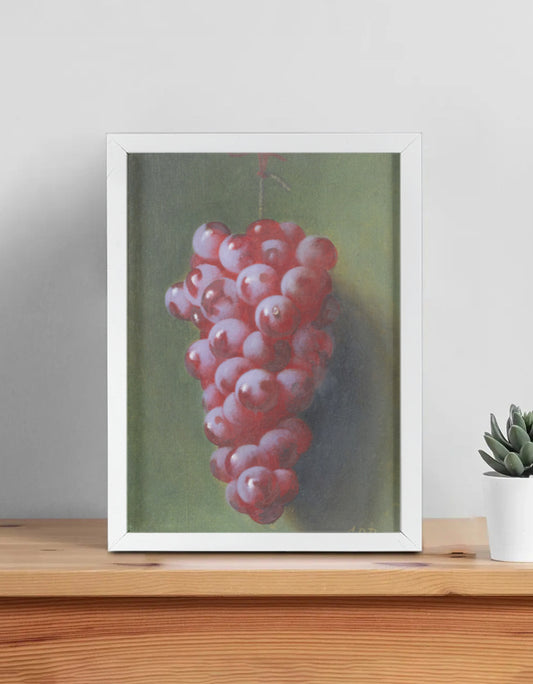
A bunch of red grapes hangs from a knotted red ribbon against a plain green wall. There is no table, no silver bowl, no wine glass. There is only fruit, light and shadow, painted so closely that every grape seems to hold a tiny window of daylight on its skin.
The painter was Cadurcis Plantagenet Ream, a largely self-taught boy from Ohio who became Chicago's best-known painter of fruit. One admiring critic called him "the King of the Fruit Painters". This small canvas, only about 36 cm tall, shows his art at its most distilled: one subject, looked at until it almost glows.
The Subject: Grapes, Fruit of Feasts and Fleeting Things
Grapes run all through Ream's career. When a large group of his paintings was auctioned in New York in 1866, one of the titles was Delaware Grapes. In the 1870s, his popular Dessert pictures, reproduced as colour prints, crowded marble tabletops with ornate silver dishes, bottles of wine, sweets and fruit.
His grand A Regal Dessert, from about the same period, sets clusters of purple grapes beside cakes and sugared raspberries. Some of those grapes are already withered or plucked from the stem.
That detail matters. The historian V. Scott Diamond links Ream's work of the 1870s to the showy Dutch still lifes of painters such as Abraham van Beyeren and Pieter Claesz. Those Dutch pictures often carried a quiet warning that worldly pleasures do not last. Dutch artists sometimes showed fruit just beginning to spoil to make that point.
Diamond lists freshly picked grapes among the "overtly transient" things Ream liked to paint, alongside chilled ice cream and flowers in full bloom. He also suggests that, in an America still recovering from civil war, such pictures spoke softly of loss. Ream knew that loss at first hand. His elder brother, Thaddeus, was wounded at the Battle of Shiloh in 1862 and died two years after his discharge.
Reading the Painting
The ribbon and the hanging bunch
The grapes do not rest on a plate. They hang from their stem by a cord, tied at the top with a red ribbon bow. Ream sometimes painted fruit hung up like this rather than set on a table.
The idea recalls a favourite trick of 19th-century American still life: objects tied or tacked to a wall board and painted so convincingly that the eye is almost fooled. That deceptive style is called trompe-l'œil, French for "deceive the eye". Painters such as William Michael Harnett and John Frederick Peto made it famous. Ream's grapes are gentler, but the same pleasure is there: the feeling that you could reach out and lift the bunch off its hook.
The bloom and the gleam
Look closely and each grape has two kinds of light. There is a bright, wet highlight where the window light strikes it, and a soft, cloudy, bluish sheen, the natural bloom of the fruit.
Painting bloom was Ream's speciality. A Chicago critic in 1905 singled out his skill with the bloom on a peach. The same critic praised the clear, luminous colour he achieved when light fell on fruit from behind. Here you can see that care in miniature: the red deepens to wine colour where the grapes crowd together and fades to pink where they catch the light.
The shadow on the wall
The light comes from the upper left, and the bunch throws a long, dark shadow down and to the right. That shadow is what makes the picture work. It pushes the grapes forward, off the flat green surface, and gives them weight. Without it they would be a pattern; with it they are fruit hanging in a real room.
The empty green ground
Compared with the crowded Dessert pictures, this canvas is almost bare. Diamond describes how Ream's style changed during the 1880s, from hard-edged, elaborate arrangements towards softer contours, less artificial set-ups and a stronger interest in light.
This painting carries no date, and we place it in the 1870s and 80s. It sits comfortably between those two moods: crisp and precise, yet stripped down to one natural subject and the light falling on it.
The signature
In the lower right corner, in pale paint, the artist has signed his name: C.P. Ream. It is how he was most often known in his own day, and it neatly sidesteps the question of how to spell his unusual first name.
The Artist: Cadurcis Plantagenet Ream (1838–1917)
Ream was born on 8 May 1838 in Sugar Grove, near Lancaster, Ohio. Some sources give 1837, and some say Lancaster itself. His father, Jonas, was a country lawyer with a love of classical learning, and he gave his sons grand names.
Diamond suggests "Cadurcis" comes from a brave Gaulish warrior mentioned by Julius Caesar, and "Plantagenet" from the medieval royal house of England. Many sources, including several galleries, spell the first name "Carducius". Sources are divided, and both forms appear in print. His younger brother, Morston Constantine Ream, also became a well-known still-life painter.
His childhood was marked by grief: his only sister died as a baby, and his mother died when he was a small boy. He went to public schools in Lancaster. The National Cyclopaedia of American Biography describes him as self-taught.
The earliest known mention of his work dates to about 1858 or 1859. A Cleveland newspaper reported that a 20-year-old C. P. Ream was showing a painting of two coconut halves in a shop window.
By 1866 he was probably in New York. By the early 1870s, he and Morston shared a studio near Union Square. In 1878 he moved to Chicago for good, and the city took to him.
During the 1880s and 1890s he travelled back and forth to Europe. Munich seems the likeliest place he studied, though records are thin. He married Maria Gatzmeyer of Hanover in 1882, and their only son was born the following year.
He exhibited fruit pieces at the Royal Academy in London in 1892 and 1898. Several sources claim he also showed at the Paris Salon, but Diamond found no direct evidence of this.
Ream was a canny self-promoter. He held his own auctions, staged eye-catching exhibitions and, according to some accounts, used professional promoters.
In 1895, he was called a one-man show. In 1899 a collector's gift made him, by contemporary report, the first Chicago artist represented in its permanent collection. Diamond names that painting Just Gathered; Wikipedia calls it Purple Plums.
His last years were hard. He grew deaf and frail, and his right hand and arm became paralysed, probably from a stroke. Wikipedia places this in 1909, while Diamond suggests around 1911 or a little later. He died in Chicago on 20 June 1917 and was buried in Lancaster, Ohio.
The History of This Image
Ream's name first reached ordinary homes through colour prints. Around 1870 he began supplying paintings to L. Prang and Company of Boston, run by the German-born printer Louis Prang. Prang used many printing stones for each picture to imitate the colour and sheen of an oil painting.
Prang's catalogues of the 1870s listed Ream's pictures as numbered Desserts. Dessert No. 3 appeared in 1871, and four Desserts were offered in 1876.
These prints, called chromolithographs or "chromos", were enormously popular. The historian Lori Rotskoff notes that chromolithographs in America sold by the millions between 1840 and 1900. Still-life chromos were especially associated with decorating the dining room. Harriet Beecher Stowe even urged readers to hang them at home.
Later in his career, some of Ream's paintings were reproduced for wide sale by the National Book and Picture Company. We have found no record that this particular canvas was ever turned into a print in his lifetime. Its story is simply that of a small, carefully made painting by a man whose fruit pictures many Americans loved.
Why It Endured
For nearly 60 years after his death, Ream was almost forgotten. Interest returned only with the revival of American still-life painting in the late 1960s and 1970s. Since then, more of his paintings have come to light.
Diamond argues that Ream fills a gap in the story of American art. Histories of the period tend to focus on Harnett and Peto. Behind them, though, stood a large group of painters continuing a still-life tradition that began with the Peale family of Philadelphia after the American Revolution. Diamond believes Ream deserves to be counted among its leaders.
This little painting shows why. It needs no story, no props and no expensive silver to hold your attention. It asks you to look at something ordinary, a bunch of grapes, and notice how beautiful and how brief ripeness is.
About This Print
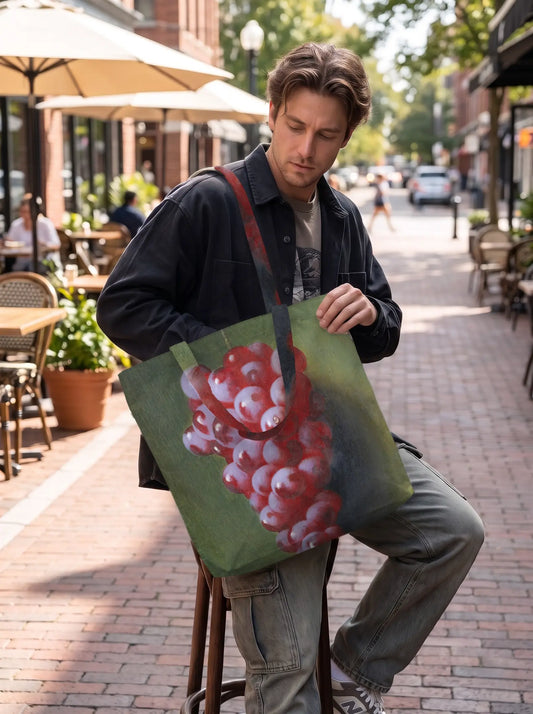
The original is an oil painting on canvas by Cadurcis Plantagenet Ream, American, undated and placed in the 1870s–80s. It measures 35.6 × 24.4 cm (14 × 10 in) and is signed "C.P. Ream" in the lower right corner. Our print reproduces the full composition: the ribboned bunch, its shadow and the green ground.
How We Restored It
We restored this image digitally, working only on the image file and never on the painting itself. We gently cleaned away stains, scuffs and small marks of age, especially near the edges, and reduced grain without smoothing away the brushwork.
We then sharpened fine detail, such as the highlights and soft bloom on each grape, and corrected the colour carefully against the source so the reds and greens stay true to Ream's palette. Some AI-assisted tools helped with this work, and every change was checked by eye.
Bringing It Home
- Dining room: a natural fit for a fruit still life, just as these pictures were in Ream's day
- Kitchen or breakfast nook: a warm, quiet touch of colour
- Bar or wine corner: grapes on the wall, wine on the shelf
- Study or reading corner: small, calm and rewarding to look at closely
- Housewarming gift: a classic, welcoming picture for a new home
- Anniversary or wedding gift: a symbol of ripeness and plenty
- For wine lovers and food lovers: a thoughtful gift with a real story
- Festive gifting: a graceful choice for Diwali or the harvest season
Quick Facts
- Title: Still Life with Grapes
- Artist: Cadurcis Plantagenet Ream (1838–1917)
- Also known as: Carducius Plantagenet Ream; C. P. Ream
- Born: 8 May 1838, Sugar Grove, near Lancaster, Ohio (some sources give 1837)
- Died: 20 June 1917, Chicago
- Date: Undated; 1870s–80s
- Medium: Oil on canvas
- Size: 35.6 × 24.4 cm (14 × 10 in)
- Signed: "C.P. Ream", lower right
- Style: Realism
- Subjects: Still life, botanical
- Nationality: American







Join the conversation
Comments
What does this painting mean to you?
Log in to join the conversation
No password needed. We email you a one-time code.
Awaiting approval
No comments yet. Be the first to share your thoughts.