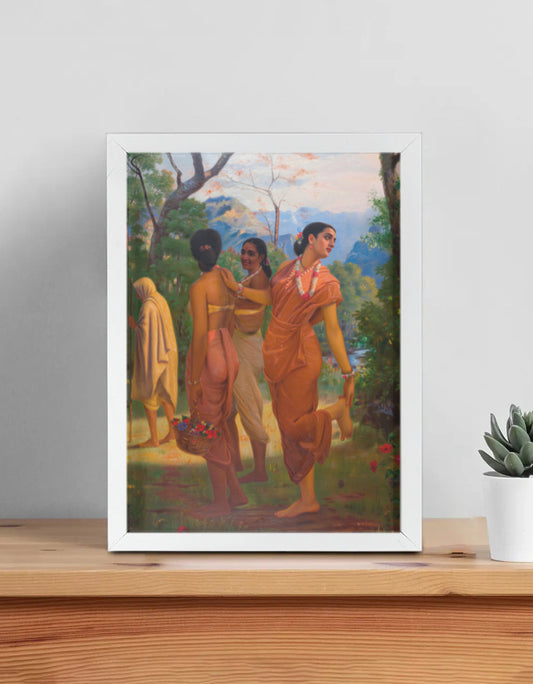
A young woman is walking home through a forest grove with her two friends. Suddenly she stops, as if a thorn has caught her foot. But her eyes are not on her foot at all. Her head has turned the other way, back down the path, towards a man we cannot see.
Raja Ravi Varma painted this small act of make-believe in 1898. It comes from one of the best-loved scenes in Sanskrit literature: the moment a girl of the hermitage, newly in love with a king, invents an excuse to look at him one more time. Anyone who has ever lingered at a door for a last glance will recognise exactly what she is doing.
Who is Shakuntala?
Shakuntala's story is first told in the Mahabharata, but the version most people know is Kalidasa's Sanskrit play Abhijnanashakuntalam, "The Recognition of Shakuntala". Reference works differ on its date. Some place Kalidasa in the 4th century CE; others date the play to about the 5th century CE.
In the play, Shakuntala is the daughter of the nymph Menaka and the royal sage Kaushika. Abandoned as a baby, she is raised by the hermit Kanva in his forest hermitage on the river Malini, where she waters the trees and calls a flowering creeper her sister.
One day King Dushyanta, of the line of Puru, chases a deer into the grove. Hidden behind a tree, he watches Shakuntala talking with her friends and falls in love. They later marry in secret, and before he returns to his capital he gives her a ring engraved with his name.
Then fate turns. Lost in thoughts of her husband, Shakuntala fails to greet the short-tempered sage Durvasas, who curses her: her lover will forget her until he sees a token he gave her. On the way to court she loses the ring while worshipping at the Ganges, and the king does not know her. Only when a fisherman finds the ring inside a fish does his memory return. The lovers are finally reunited in heaven, with their son Bharata, the ancestor after whom Bharatavarsha is named.
Kalidasa's great change to the old story, as Britannica notes, is that Dushyanta is not to blame. He rejects Shakuntala only because of the curse.
Reading the painting
The canvas shows the very end of the play's first act, long before any curse. The two have only just met.
The backward glance
In the play, the hermitage is suddenly thrown into alarm: the king's soldiers are near, and a frightened elephant is crashing through the grove. The girls must hurry home, and Shakuntala obeys with her feet but not her heart.
The art historian Tapati Guha-Thakurta writes that the twist and turn of her head and body draws the viewer into the story, so that the painting stands "like a still from a moving film". We sense the moment before and the moment after.
The thorn that wasn't
The English title speaks of a thorn. In Arthur W. Ryder's 1912 translation of the play, Shakuntala tells her friend Anusuya, "my foot is cut on a sharp blade of grass," and adds that her dress has caught on an amaranth twig. She asks her friend to wait while she frees it, casts a lingering glance at the king, and leaves.
In the next act the king remembers the moment fondly. She had cried that she could not walk, he recalls, then turned her face and pretended to free a dress that was not caught at all. Whether thorn or grass, the hurt is a fiction. The glance is the truth.
The two friends
Shakuntala's companions in the play are Anasuya and Priyamvada, and they tease her without mercy. When a bee buzzes round her face, they laughingly tell her to call on King Dushyanta for help, not knowing he is listening.
Ravi Varma keeps that playful spirit: in the painting, too, the friends are teasing her, and they are not fooled. They are the audience inside the picture.
The king outside the frame
Dushyanta is nowhere on the canvas, yet the whole painting points to him. Guha-Thakurta observes that the absent lover is the picture's pivot: his unseen gaze turns Shakuntala, like Ravi Varma's Damayanti, into an image of desire, a poetic and sensual ideal.
That reading carries a criticism too. Historians have asked how far such heroines were painted for a male viewer's pleasure. The painting is tender, and it is also very aware of being looked at.
The hermitage grove
Kalidasa sets his first four acts in Kanva's hermitage, a place of trustful deer, watered trees and quiet ritual. It is the whole world Shakuntala has known.
The artist
Raja Ravi Varma was born on 29 April 1848 at Kilimanoor Palace, near Trivandrum (now Thiruvananthapuram), in the princely state of Travancore. As a boy he drew on the palace walls, and his uncle Raja Raja Varma noticed and gave him his first lessons.
At 14 he found a patron in Ayilyam Thirunal, the ruler of Travancore. He was taught watercolour by Rama Swami Naidu, and about three years later began to study oil painting with the British portraitist Theodore Jensen.
Fame followed: an award at an exhibition in Vienna in 1873, three gold medals at the World's Columbian Exposition in Chicago in 1893, and the Kaisar-i-Hind Gold Medal in 1904. He painted Indian and British sitters, but became best known for joining Hindu mythology and Sanskrit literature to the realism of European academic painting.
He died on 2 October 1906. Here too the sources differ: Britannica gives the place as Kilimanoor Palace, while Wikipedia names Attingal.
The history of this image
Ravi Varma returned to Shakuntala again and again. His Shakuntala Patra-lekhan, showing her writing a love letter to Dushyanta, was shown at the Madras Fine Arts Exhibition of 1876 and won him praise; one account says it took a gold medal. A Shakuntala painting of his later appeared as the frontispiece to Monier Monier-Williams's 1887 edition of the play.
By the 1890s he was also a publisher of pictures. On the urging of T. Madhava Rao, a former Diwan of Travancore, he and his brother C. Raja Raja Varma set up a lithographic press with German machinery and the German printers Fritz Schleicher and B. Gerhardt. The first chromolithograph it printed, in 1894, was fittingly a Shakuntala subject: Shakuntala Janm, "The Birth of Shakuntala". Lakshmi and Saraswati followed.
Accounts of the press differ. One places its start in Girgaum, Bombay, with a move to Ghatkopar in 1898 after the plague; another says it began in Ghatkopar. It moved to Malavli near Lonavala in 1899 by one account, from 1901 by another. In 1901 the brothers sold the majority interest to Schleicher for Rs 25,000, with copyright for more than a hundred paintings. A fire destroyed the factory in 1972.
This large oil, sometimes called Shakuntala Looking for Dushyanta, was painted in 1898, in the middle of those busy press years.
Why it endured
Part of the answer lies in the play itself. In 1789 Sir William Jones published an English translation, the first Indian drama translated into a Western language. Goethe wrote an epigram about Shakuntala in 1791, and within a century there were at least 46 translations in twelve European languages.
Part lies with Ravi Varma. His prints, and those of the press after him, helped create a shared pan-Indian picture of gods, heroines and epic scenes. In a 1991 essay, Guha-Thakurta traced how such pictures of women hardened into the familiar types of popular calendar prints.
Opinion on him has always been divided. Some dismissed his work as "calendar art", and Ratan Parimoo criticised it as kitsch. Yet interest never faded: the critic Geeta Kapur called him the "indisputable father figure" of modern Indian art, and the artist Pushpamala N. has restaged several of his paintings with herself in the leading role.
And part of the answer is simply human. Pretending to be hurt so you can look back at someone is not mythology. People still do it.
About this print
The original is an oil painting on canvas by Raja Ravi Varma, made in 1898. It is a large, upright canvas, about 181 cm tall and 110 cm wide. Our print reproduces its full composition.
How we restored it
Our restoration is entirely digital. Nothing has been repainted, and the original canvas has not been touched.
Working on a high-resolution image of the painting, we cleaned away stains, specks and surface damage and gently reduced grain. We sharpened fine detail with care and corrected colour against the source, so skin tones and fabrics stay true to the painting. Some steps used AI-assisted tools, and every change was checked by eye.
Bringing it home
The tall format suits narrow walls and quiet corners.
- A living room or hallway wall that needs a tall, upright picture
- A bedroom, where its story of first love feels at home
- A study or reading nook for lovers of Kalidasa and Indian literature
- A wedding or anniversary gift
- A Valentine's Day gift for someone newly in love
- A gift for a student, teacher or reader of Sanskrit drama
Quick facts
- Title: Shakuntala Removing a Thorn from Her Foot
- Also known as: Shakuntala; Shakuntala Looking for Dushyanta
- Artist: Raja Ravi Varma (1848–1906)
- Date: 1898
- Medium: Oil on canvas
- Size of original: About 181 × 110 cm
- Style: Academic art
- Subjects: Literature, mythology
- Source text: Kalidasa's Abhijnanashakuntalam, end of Act I
- Characters: Shakuntala with her friends Anasuya and Priyamvada; Dushyanta, unseen




Join the conversation
Comments
What does this painting mean to you?
Log in to join the conversation
No password needed. We email you a one-time code.
Awaiting approval
No comments yet. Be the first to share your thoughts.