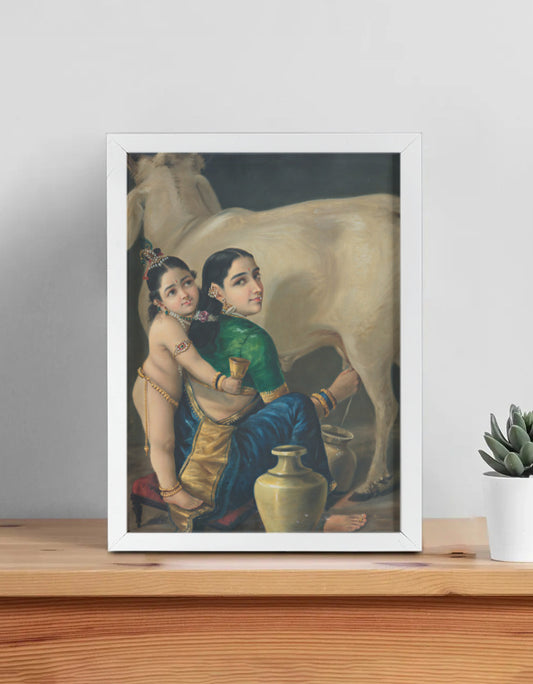
Yashoda has been milking a cow when her little son comes for his share. She leans towards him, the work forgotten for a moment, while the child stays close beside her with a golden goblet. There is no demon here, no battle, no miracle. Just a mother, a child and a patient cow behind them.
Yet the child is Krishna. Raja Ravi Varma painted this quiet scene in the 1890s, at the height of his career, and it is now counted among his finest works. It has even been called the "Mona Lisa of Indian art". In April 2026 it set a new auction record for Indian art.
Who are Yashoda and Krishna?
Krishna is one of the most widely revered gods of India. He is worshipped as an avatar of Vishnu and as a supreme god in his own right, and devotion to him has produced a vast body of poetry, music and painting.
His life began in danger. He was born to Devaki, and Kamsa, the ruler of Mathura, planned to kill him. According to the Bhagavata Purana, his father Vasudeva carried the newborn to Gokula and left him with Nanda, the chief of Gokula, and his wife Yashoda. She raised him as her own son.
The tenth book of the Bhagavata Purana is full of their life together. In one passage (10.8), Krishna is accused of eating mud, and when he opens his mouth Yashoda sees the entire universe inside. In another (10.9), she is churning yogurt herself and singing about her child. He comes wanting to nurse and grabs the churning rod to make her stop. She takes him on her lap, then sets him down to save milk boiling over on the stove. The offended child breaks the pot and helps himself to fresh butter. The same chapter says that not even Brahma, Shiva or the goddess of fortune received the kind of grace that Yashoda received from her son.
Saffronart's catalogue places Ravi Varma's painting in this tenth book. It shows Yashoda milking a cow as the infant Krishna comes to her for milk, and the catalogue mentions churning butter too.
Reading the painting
Saffronart's catalogue sorts Ravi Varma's sacred subjects into two kinds. His Puranic paintings are large and crowded, built around a dramatic turning point. His religious paintings, like this one, are quieter, using the same academic realism to hold a single mood. The figures are modelled with chiaroscuro, the contrast of light and shadow he took from European academic painting.
The cow
The cow sits in the background, yet it fills a large part of the canvas. Saffronart's catalogue notes that it is painted with very little detail, so our eyes stay on mother and child. The catalogue reads it as a nod to Kamadhenu, the sacred cow regarded as the mother of all cows and a symbol of prosperity and abundance.
A pale-skinned Krishna
Ravi Varma borrows the child-god of Tanjore painting, the Navaneeta Krishna. But he paints him with pale skin instead of the deep blue usually given to the deity.
The golden goblet
The Art Newspaper and The Heritage Lab describe Krishna holding a golden goblet. Coverage of the sale says he is reaching from behind for a cup of milk. Saffronart's catalogue essay names no vessel at all, only the milk he has come for.
Two gazes
Both figures face us. Saffronart's catalogue says Yashoda leans gently towards the child while her gaze travels beyond the frame. The Heritage Lab reads her as looking straight at the viewer, conscious of the divine responsibility resting on her, while Krishna looks into the distance. As in many of Ravi Varma's pictures, it feels as though the figures have paused for a moment.
Silk, gold and pearls
Yashoda wears an ultramarine sari. The Heritage Lab points to how carefully its folds are handled, and how its vivid colours echo the peacock feather on Krishna's head. She wears a fan-shaped visiri-murugu earring and a jhumka. The child wears a sarpech ornament on his turban, a pearl necklace and a bazuband on his arm. Saffronart's catalogue, citing Rupika Chawla, notes that the Varma brothers knew gems well.
The signature
In the lower right, the canvas is signed and inscribed "By Ravi Varma / Coil Tampuran / Travancore / India".
The artist
Raja Ravi Varma was born on 29 April 1848 at Kilimanoor Palace, near present-day Thiruvananthapuram, in the princely state of Travancore. In 1862 he was introduced to Maharaja Ayilyam Thirunal and trained as a court artist. He learnt watercolour from Rama Swami Naidu. He learnt oil painting largely by studying the visiting British portraitist Theodore Jensen.
Britannica counts him among the first Indian artists to use oil paints. It says he is best known for uniting Hindu mythology with European realist painting. Besides gods and epic scenes, he painted portraits of Indian and British sitters. Honours followed:
- an award at Vienna in 1873
- three gold medals at the World's Columbian Exposition in Chicago in 1893
- the Kaiser-i-Hind gold medal in 1904
The art historian Geeta Kapur called him the "indisputable father figure of modern Indian art". Not everyone agreed: the critic Ratan Parimoo dismissed his work as kitsch.
He died on 2 October 1906, aged 58. Britannica places his death at Kilimanoor Palace; Wikipedia says Attingal.
The history of this image
Many Yashodas
Ravi Varma painted the infant Krishna and Yashoda more than once. Another of these paintings, from the family collection of Fritz Schleicher, sold at Pundole's in Mumbai in 2023 for ₹38 crore. A chromolithograph dated 1895, also titled Yashoda Krishna, shows a different scene: Krishna on the lap of an adoring Yashoda, with a maid looking on.
From canvas to print
The earliest known reference to this painting is in S. N. Joshi's 1911 book Half-Tone Reprints of the Renowned Pictures of the Late Raja Ravi Varma, where it is titled Milching a Cow. A chromolithograph of it was printed at the Ravi Varma Press as Yashoda Krishna.
That press began work in Bombay in 1894; Wikipedia places it in Ghatkopar. Ravi Varma's brother Raja Varma managed it, but it fell deep into debt. It moved to Malavli, near Lonavala, in 1899 and was sold in 1901 to the German printing technician Fritz Schleicher. The Heritage Lab describes Schleicher as involved from the founding. A fire in 1972 destroyed the factory and many original prints.
A canvas in the spotlight
The painting is illustrated in Rupika Chawla's monograph Raja Ravi Varma: Painter of Colonial India (Mapin, 2010). In recent years it has been on public view in three exhibitions:
- Navratna: Nine Gems, Mumbai, 2018
- Drishyakala, the Red Fort, Delhi, 2019 to 2022
- Bhakti: The Art of Krishna, NMACC, Mumbai, 2024
In 2023 a whole book was published about it, with essays by Partha Mitter, A. Ramachandran and others.
On 1 April 2026, at Saffronart's Spring Live Auction in Mumbai, it sold for ₹167.2 crore (about US$17.98 million) against an estimate of ₹80–120 crore. That beat the record held by M. F. Husain's Untitled (Gram Yatra). Its new owner said: "This national treasure deserves to be made available for public viewing periodically." As a registered antiquity and national art treasure, it cannot leave India.
Why it endured
A mother with her child needs no explaining. Saffronart's catalogue compares the subject to the Madonna and Child of European art. It also notes the long life of the Yashoda and Krishna image in Indian temple carving and painting.
The artist A. Ramachandran, quoted in the catalogue, argues that a formal icon inspires awe rather than affection. Ravi Varma closed that gap by pairing the bhakti idea of a god you can approach personally with European realism. The result, in Ramachandran's words, is "a new intimacy between gods and humans".
Prints did the rest. His oleographs carried such images into ordinary homes and kept being printed in thousands long after his death. Esquire India credits him with largely shaping how Hindu gods look in calendars and posters. Saffronart notes his influence on early Indian cinema, including on Dadasaheb Phalke and Baburao Painter. More than a century on, his prints of the gods still hang in many Indian homes.
About this print
Our print is made from an image of the original oil painting itself, not from a later chromolithograph or calendar print.
The original is an oil on canvas of about 89 × 72 cm (35 × 28.25 in), held in a private collection in India. Saffronart catalogues it as circa 1890s. Its title, subject, size and exhibition history all match the painting that sold in April 2026, though no source we read says so in one line.
How we restored it
Our restoration is digital only. Nothing was repainted, and the original canvas was never touched.
We cleaned stains and surface damage, reduced grain, and sharpened detail in the faces, jewellery and sari folds. Colour was corrected against the source so the ultramarine sari stays true. Some steps use AI-assisted tools, and every change is checked by eye.
Bringing it home
- Puja room or mandir corner, as a gentle image of Krishna's childhood
- Living room, where a large print holds the wall
- Nursery or child's room
- Janmashtami, a natural gift for the festival of Krishna's birth
- Baby shower, godh bharai or naming ceremony
- Mother's Day or a mother's birthday
- Housewarming or Diwali
Quick facts
- Title: Yashoda and Krishna (titled Milching a Cow in 1911; printed as Yashoda Krishna)
- Artist: Raja Ravi Varma (1848–1906)
- Date: c. 1890s
- Medium: Oil on canvas
- Size: About 89 × 72 cm (35 × 28.25 in)
- Subject: Yashoda milking a cow as the infant Krishna comes for milk
- Source text: Tenth book of the Bhagavata Purana
- Style: Academic art
- Signed: Lower right
- Status: Registered antiquity; non-exportable national art treasure
- Auction record: ₹167.2 crore, Saffronart, Mumbai, 1 April 2026




Join the conversation
Comments
What does this painting mean to you?
Log in to join the conversation
No password needed. We email you a one-time code.
Awaiting approval
No comments yet. Be the first to share your thoughts.