The goddess who came home
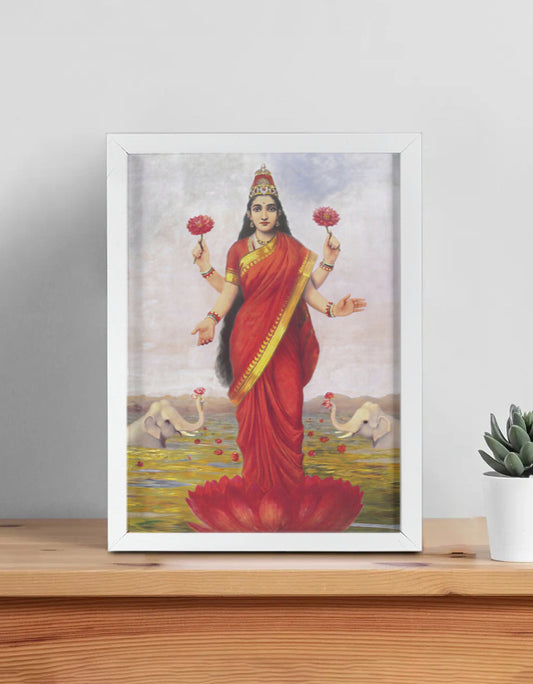
Close your eyes and picture Lakshmi. You probably see a calm young woman rising from the water on an open lotus, four arms raised in blessing, a sari falling in soft folds and a crown catching the light. Writing in Open magazine, Nanditha Krishna observed that this is how most people now imagine the goddess: the way Raja Ravi Varma painted her.
This canvas, dated 1896, is one of the Lakshmis he painted in oil. It belongs to a family of images that travelled from a painter's studio to a printing press, and from there into homes, shops, calendars and even silverware across India. More than a century later, that family of images still shapes how the goddess of fortune is pictured.
Who is Lakshmi?
Lakshmi is the Hindu goddess of wealth and fortune, and the wife of Vishnu. Britannica notes that she is said to take a different form to be with him in each of his incarnations. Her oldest names carry her meaning. Sri speaks of radiance and wealth, while Padma and Kamala both mean "she of the lotus".
Her best-known story is the churning of the ocean. In the version told in the Vishnu Purana, the gods and demons churned the ocean of milk, and Lakshmi rose from the waters bearing a lotus. She chose to stand with the gods, and chose Vishnu as her husband.
She is worshipped above all at Diwali, the festival of lights, and again during Navaratri. Friday is her day, and married women keep the Varalakshmi Vratam in her honour. In one ancient form, Gajalakshmi, she is attended by two elephants, a sign of both fertility and royal authority.
Reading the painting
Ravi Varma kept the old signs of the goddess, but painted them with the light, shadow and depth of European oil painting. Britannica sees this union of Hindu myth with European realism as the heart of his art, and DailyArt Magazine credits him as the earliest Indian artist to use chiaroscuro, the Western play of light and dark.
The lotus beneath her feet
In this canvas Lakshmi stands on an open lotus. The flower is her oldest emblem, and her very names come from it. The lotus stands for purity whatever the circumstances it grows in, and also for fortune, self-knowledge and spiritual freedom.
Four arms
Her four arms are traditionally read as the four aims of a good life: dharma (right conduct), artha (prosperity), kama (love and pleasure) and moksha (liberation).
Blossoms and open hands
In Ravi Varma's Lakshmi images, the upper hands lift lotus blossoms while the lower hands make two old gestures: abhaya, the gesture of protection, and varada, the gesture of blessing and granting wishes. Traditional images of the goddess often add gold coins. DailyArt Magazine notes that his version leaves the coins out.
The sari
Lakshmi is traditionally dressed in red worked with golden thread, a colour of fortune and wealth. Ravi Varma was known for painting saris well, and drew on the styles he saw among women in Bombay, where he spent many years. The art historian Vidya Dehejia notes that the drape he gave Lakshmi in his famous print belonged to no single regional tradition at the time. It became fashionable because the print was so popular, and is now the standard way of wearing a sari.
Crown and jewellery
DailyArt Magazine points out that his Lakshmi wears a crown in the Tanjore style. He admired the gilded Tanjore paintings of the south, and his close attention to costume and jewellery reflects that taste.
The open sky
Dehejia identifies this 1896 canvas as one of a pair, painted with a Saraswati seated by the water with her veena and peacock. Here the goddess is set against an open, sky-filled background. An earlier Lakshmi oil, the one his famous print follows, places her instead against woods and distant hills.
A human face
Ravi Varma used live models for his goddesses. DailyArt Magazine names a Goan woman, Rajibai Moolgavkar, as the model for both his Saraswati and his Lakshmi. Like other Indian artists, he idealised the face so that it no longer resembled the model, because a goddess had to be perfect.
The artist
Raja Ravi Varma was born on 29 April 1848 at Kilimanoor, in the princely state of Travancore, in today's Kerala. His family was linked by marriage to the state's rulers, and his mother was a poet and writer.
Accounts of his training differ. The Impart encyclopedia says his uncle gave him his first drawing lessons, that the master painter Ramaswamy Naidoo refused to teach him, and that Naidoo's assistant, Arumugham Pillai, introduced him to oils, so his skill was largely self-taught. Other accounts say Rama Swami Naidu trained him in watercolour and the European portraitist Theodore Jenson, reluctantly, in oils.
Success came in 1873, when Nair Lady at Toilet won the Governor's Gold Medal at the Madras Fine Arts Exhibition. He also won an award at an exhibition in Vienna that year. Royal patrons followed, above all Maharaja Sayajirao Gaekwad of Baroda, who in 1888 commissioned fourteen mythological paintings for his new palace. From about 1880 his younger brother, C. Raja Raja Varma, worked beside him and painted many of his backgrounds and landscapes.
In 1904 the Viceroy, Lord Curzon, awarded him the Kaisar-i-Hind Gold Medal. He died on 2 October 1906. Britannica places his death at Kilimanoor, while other accounts give nearby Attingal.
The story of this image
From canvas to print
Ravi Varma painted Lakshmi more than once in oil, and one version became a print. Sources disagree on when it first appeared. Britannica dates a Lakshmi lithograph to 1894, and Open magazine says Lakshmi was the second print his press released, after The Birth of Shakuntala in July 1894. Dehejia dates the large print to about 1896.
It was a big print, more than 70 cm tall. Dehejia notes that large lithographs of this kind used thirteen colours, each printed from its own stone. According to Open, Lakshmi sold for two rupees, as did Saraswati, a price within reach of ordinary households.
The press
The idea of printing his paintings was urged on Ravi Varma by T. Madhava Rao, Dewan of Baroda. The Ravi Varma Fine Art Lithographic Press opened in Bombay, in partnership with Govardhandas Khatau Makhanji. Most sources date it to 1894; Dehejia gives 1893. Some place it first in Girgaum, others in Ghatkopar. In 1899 it moved to Malavli, near Lonavala.
The press was run by Fritz Schleicher, a German printer, whom Raja Raja Varma's diaries called the "Printer of the Gods". It struggled for money and was sold to Schleicher, in 1901 by some accounts and 1903 by others. He kept printing the images and used them on calendars, advertisements, postcards, playing cards and matchbox covers. One account says a fire destroyed the factory in 1972; others date the fire to 1973 and the final closure to 1980.
A goddess dressed by her devotees
People did not simply hang the print; they adorned it. Open records that women in Tamil Nadu dressed the pictures in silk and chiffon with embroidery and stones, and that traders carried them to Burma, where women dressed the goddess in silk saris with zari work. Soon after 1900, the Madras silversmiths P. Orr & Sons copied the standing Lakshmi from the lithograph onto a silver teapot and sugar bowl.
Why it endured
The print was affordable, beautiful and everywhere. Dehejia notes that other presses soon imitated it, that the imitations lived on as calendar art, and that copies of his goddesses still appear in shops, homes, taxis and auto rickshaws. The Impart encyclopedia adds that his images fed advertising and religious ceremonies, and helped inspire the new cinema ushered in by Dadasaheb Phalke.
Not everyone approved. The nationalist Bengal School felt his work fell short of a "pure" Indianness, and the critic Ratan Parimoo dismissed it as kitsch. Yet the scholar Geeta Kapur called him "the indisputable father figure of modern Indian art".
Perhaps the deepest reason is simple. He painted a goddess you could look in the eye, and families who could never own an oil painting could keep her where they prayed. When Diwali lamps are lit before a picture of Lakshmi today, the face looking back is very often his.
About this print
The original is an oil painting on canvas by Raja Ravi Varma, dated 1896, one of a pair with his painting of Saraswati. Its measurements are not given in the published sources we consulted, so we have not guessed them here.
How we restored it
Our restoration is entirely digital. Nothing was repainted, and no physical conservation was involved.
We cleaned away stains, specks and surface damage, reduced the grain that blurs fine detail, and sharpened the edges of the lotus petals, the jewellery and the folds of the sari. We then corrected the colour against the source so the warm tones sit as they should. Some steps used AI-assisted tools, and every change was checked by eye before we kept it.
Bringing it home
- A puja room or prayer corner
- An entrance or foyer, to welcome guests
- A living room wall
- A shop, office or new business
- A gift for Diwali or Lakshmi Puja
- A housewarming (griha pravesh) or wedding gift
- A gift for Varalakshmi Vratam
Quick facts
- Title: Goddess Lakshmi
- Artist: Raja Ravi Varma (1848–1906)
- Date: 1896
- Medium: Oil on canvas
- Style: Academic art, uniting Hindu subjects with European realism
- Subject: Lakshmi, Hindu goddess of wealth and fortune
- Companion painting: Saraswati
- Related print: Lakshmi, Ravi Varma Fine Art Lithographic Press, about 1894–1896
- Symbols: Lotus, four arms, abhaya and varada gestures, Tanjore-style crown




Join the conversation
Comments
What does this painting mean to you?
Log in to join the conversation
No password needed. We email you a one-time code.
Awaiting approval
No comments yet. Be the first to share your thoughts.