

The Story Behind the Painting
Krishna Entreating Radha
Unknown artist, Kangra School (Kishangarh School)·1700s

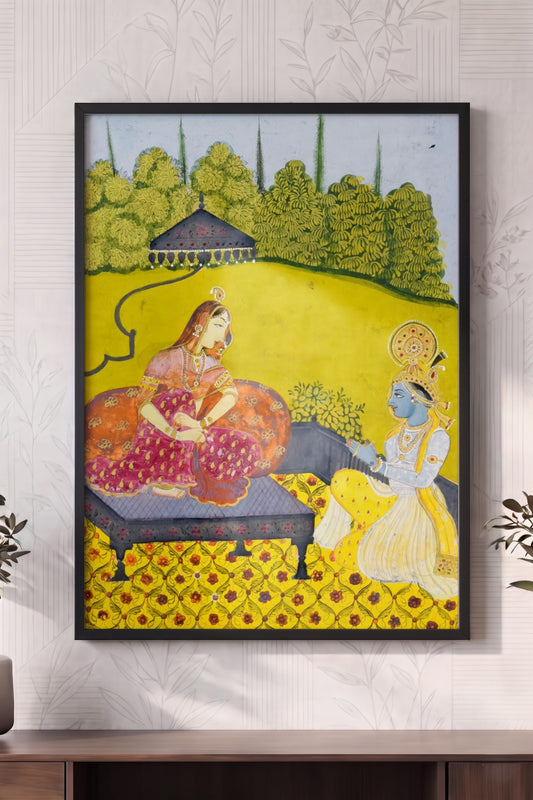
Radha won't look up, and the Lord of All is on his knees. This 1700s miniature paints maan, the proud hurt that lets a beloved make even a god wait. Behind it sits a poet who dared to have Krishna beg for Radha's foot upon his head.
- Artist
- Unknown artist, Kangra School (Kishangarh School)
- Date
- 1700s
- Medium
- Opaque pigment on paper
- Style
- Rajput miniature painting (Pahari, Kangra; also attributed to Kishangarh, Rajasthan)
- Original
- Salar Jung Museum, Hyderabad
Every family has seen this evening. Someone has been hurt, someone is trying to make it right, and the whole room can tell who is who without a word being said.
Here she sits high on a low dark seat, wrapped in crimson, knees drawn up and arms locked around them. He kneels on the carpet below, palms pressed together, face tilted up toward hers. The one doing the pleading is Krishna. The one who will decide when the quarrel ends is Radha. And the painter, working somewhere in the 1700s, wants you to feel exactly how long he has been waiting.
Who Radha is, and why she is allowed to sulk
Radha is the chief of the gopis, the cowherd women of Braj, and the beloved of Krishna. If you grew up anywhere near North India, you have heard her name more often than you realise. In the Braj country around Vrindavan and Barsana, people still greet each other with "Radhe Radhe", and in Vrindavan's temples Krishna's image rarely appears without her by his side.
Oddly enough, the Bhagavata Purana, the great book of Krishna's life in Vrindavan, never names her. Her first major appearance comes in the 12th century, in Jayadeva's Sanskrit song-poem, the Gita Govinda. She does turn up in a few earlier verses, including a Prakrit collection from the first centuries CE, but one modern writer argues that before Jayadeva the idea of Radha as Krishna's chief beloved barely existed.
Jayadeva's Radha is no shy village girl. The scholar Barbara Stoler Miller describes her as a proud, solitary figure, Krishna's partner in a mature and exclusive love. Among the names the poem gives her is Manini, the woman in maan.
Maan is the mood of this painting. Scholars of the Rasikapriya, a Hindi love poem of 1591, gloss it as pique, or wounded pride. Devotional tradition goes a step further and describes maan as a stage where love runs so deep that the devotee earns the right to be angry with God. It is a lovely, slightly cheeky idea, and it is exactly what you are looking at.
Reading Krishna Entreating Radha, one detail at a time
Why she sits high and he kneels low
Look at the levels first. Radha is raised on a low, dark seat with sturdy legs, leaning on a fat orange bolster patterned with gold flowers. Krishna is down on the floor, one knee on the carpet, his head below her shoulder.
That arrangement is theology as much as furniture. In the Gita Govinda's tenth chapter Krishna is placed beneath Radha, and he begs her in a line Miller translates as "Place your foot on my head". For a god the poem elsewhere calls the Lord of All, that is an astonishing thing to say. Every painter who seated Radha above a kneeling Krishna was quietly siding with Jayadeva.
Locked knees and lowered eyes
Radha's whole body is closed. Her knees are pulled up under a crimson skirt scattered with gold paisleys, her arms wrap around them, and her bangled wrists rest one over the other. Her long eye is lowered and heavy-lidded.
Is she looking at him, or at the floor just beside him? The painter leaves that to you. In the earliest illustrated Rasikapriya, made at Orchha, painters showed maan by having Radha rest her chin in her hand. This artist chose a quieter signal. To our eye, she hasn't turned her back on him; she just hasn't softened yet.
Folded hands in sheer white
Krishna's palms are pressed together and raised toward her, the gesture of someone asking rather than telling. He is blue-skinned as always, dressed in a sheer white robe over yellow trousers dotted with red, with a yellow sash falling from his shoulder. A wide golden crown rises behind his head like a halo.
All that royal finery, and he has put it to use asking for forgiveness. It is one of the gentlest jokes in Indian art, and it is entirely on his side.
A carpet that refuses to calm down
The floor is a yellow carpet laid with a lattice of red flowers, and the hillside behind is another sheet of strong yellow-green. If you know Kangra painting for its cool, fresh colours and its many shades of green, this heat will catch you off guard.
Rajput painting ranged from traditions that kept bright, flat colour to those, Kangra among them, that took on cooler Mughal refinement. This picture sits closer to the bright end, which may be one reason it has been labelled two different ways. More on that below.
Five cypresses against a pale sky
Behind the lovers, a dark canopy with a scalloped, pearl-fringed edge sits on the slope, backed by a bank of round, leafy trees. Above them rise five slim cypresses, needle-straight against a pale sky.
The cypress carries a long Persian and Mughal history. In Mughal garden lore, as C.M. Villiers Stuart recorded in Gardens of the Great Mughals, the dark cypress stood for death and eternity, planted beside flowering fruit trees that stood for life and hope. Artist families trained in the late Mughal style carried such motifs into the Rajput courts in the 1700s. Whether this painter meant any of that, or simply loved the rhythm of five dark spires above a quarrel, no text tells us.
Pearls you could almost pick off the page
Lean close and the jewellery seems to rise from the surface. There are strings of pearls on both lovers, a pearl edge on Radha's veil, and white dots ringing Krishna's crown.
Rajput painters built a picture in layers, burnishing each coat of colour face down on a flat surface to fuse the pigment and give it a soft shine. The final stage was called moti mahavar, pearl and henna work, where ornaments were raised in thick paint and lips and fingertips were reddened. Those little pearls are the last thing the painter touched.
Kangra or Kishangarh? The question of who painted it
Nobody signed this picture, which is normal. In the Rajput world, most paintings came out of families of painters, fathers, sons and cousins working from home and coming to court when called. The hand belongs to a tradition more than to a name.
Which tradition is the interesting part, because the records disagree. This painting is known to us as Kangra School work, the hill style of present-day Himachal Pradesh. It has also been catalogued as Kishangarh, one of the smallest Rajput states, in Rajasthan. Both fit the 1700s, and both courts were devoted to Radha and Krishna.
The Kangra case first. The style grew out of Guler, where the painter Pandit Seu and his sons Manaku and Nainsukh softened hill painting from around 1730. Nainsukh, who lived from about 1710 to 1778, is credited with inventing the classic Pahari landscape, a green slope dotted with trees rolling toward rounded hills under the sky. You can see a cousin of that idea behind Radha. Kangra painting then flowered under Raja Sansar Chand, a devoted follower of Krishna who ruled from the mid-1770s into the 1820s and kept his painters busy with the loves of Krishna.
Now Kishangarh. In the mid-1700s, Raja Sawant Singh, a Krishna devotee who wrote poetry as Nagari Das, and his painter Nihal Chand created a Radha with arched brows, long lotus-like eyes and a pointed chin, said to be modelled on the court singer Bani Thani. That face became famous enough for India to put it on a postage stamp in 1973. Even Sawant Singh's reign is dated differently by different writers, ending in 1757 or 1764.
Our honest reading is that Radha's long eye and the hot, flat colour lean toward Rajasthan, while the tree-dotted hillside leans toward the hills. We would rather tell you that than pretend the question is settled.
From a poet's nerve to the hill courts
The story behind this image starts with a poet losing his nerve. Legend says that after Jayadeva wrote Krishna's plea for Radha's foot, he was shaken by his own daring, struck out the lines and went for an oil bath. While he was away, Krishna came in the poet's own form, wrote the verse back in, ate the meal Jayadeva's wife Padmavati served him, and left. Jayadeva returned to find the line restored and his wife already eating, and understood who had visited.
The poem travelled far. The Gita Govinda is still sung every night at the Jagannath temple in Puri, and Sir William Jones published an English translation in 1792, which reached Goethe through a German version.
Four centuries after Jayadeva, in 1591, the poet Keshavdas wrote the Rasikapriya in Braj at the court of Orchha. It sorted lovers into types and moods, and the lovers in its examples are always Radha and Krishna. Many of its poems give a voice to the sakhi, Radha's friend and confidante, who tries to bring the pair back together when Radha is in maan. Rajput painters illustrated it again and again, and the love it describes became a central theme of Kangra painting.
Then the 1700s shook painters loose. When Nader Shah sacked Delhi in 1739, artists who could flee did, and many found work at Rajput courts. Families trained in the late Mughal manner settled in the hills too. Their finer line and gentler colour met old devotional subjects, and scenes of the lovers quarrelling and making up became a favourite of the new court painting. In 1812, when Sikh forces invaded Kangra, many hill artists moved once more, to the court of Maharaja Ranjit Singh.
Kishangarh's best paintings, meanwhile, stayed out of public sight for nearly two centuries. In 1943 Eric Dickinson, a professor of English at Mayo College in Ajmer, came across them in a palace collection, and the art world suddenly had a new Radha to fall for.
Why a sulking Radha never went out of fashion
Partly because everyone has been on one side of this picture. The god who can do anything still has to wait for a glance, and the one who is hurt gets to decide when she is ready. Devotional writers have long read the pair as the soul and the divine, with Radha's longing standing in for ours.
It also never left everyday life. In Barsana, the town where tradition says Radha grew up, there is a temple called the Maan temple. Ashtapadis from the Gita Govinda are still danced in Odissi. Radhashtami, Radha's birthday, falls fifteen days after Janmashtami, and a whole generation came to know the pair through the TV serial RadhaKrishn, which began in 2018.
The painting tradition itself has had to fight for its life. Kangra painting received a Geographical Indication tag on 2 April 2012, and in 1973 the Himachal government opened a training centre for young artists at Rait in the Kangra valley. Even so, reports from the 2020s describe the art as close to extinction.
About this print
The original is an 18th-century miniature painting by an unnamed artist, made with opaque pigment on paper in the Rajput manner. It has been described as Kangra School work and also catalogued as Kishangarh.
How we restored it
Our work was entirely digital. We cleaned away stains, specks and small areas of damage, and corrected the colour against the source so the yellows and crimsons sit true. Some AI-assisted tools helped along the way, and every change was checked by eye. Nothing was repainted, and no physical conservation was involved.
Bringing it home
- A bedroom wall, for a couple who know how quarrels end
- A reading corner or study, where you will keep finding new details
- A pooja room or prayer corner devoted to Radha and Krishna together
- A wedding or anniversary gift
- A Janmashtami or Radhashtami present
- A peace offering, for someone you owe an apology
Quick facts
- Title: Krishna Entreating Radha
- Artist: Unknown painter, Kangra School (also catalogued as Kishangarh School)
- Date: 1700s
- Medium: Opaque pigment on paper
- Style: Rajput miniature, Pahari (Kangra) or Rajasthani (Kishangarh)
- Subjects: Krishna and Radha
- Mood: Maan, Radha's wounded pride, and Krishna's plea
- Poetry behind the theme: Jayadeva's Gita Govinda (12th century); Keshavdas's Rasikapriya (1591)
- Look for: Five cypresses, a pearl-fringed canopy, a flowered yellow carpet
Take This Art Into Your Life
Every piece is printed to order and delivered free across India.
-
Krishna Entreating Radha, Kangra School — Framed Poster & Canvas
Regular price From ₹849Regular price

More Artworks to Explore
-
 Flowers in a Blue VaseVincent van Gogh
-
 Goddess LakshmiRaja Ravi Varma
-
 Green River Cliffs, WyomingThomas Moran
-
 Krishna's Embassy to DuryodhanaRaja Ravi Varma
-
 Radha and KrishnaRaja Ravi Varma
-
 Rama Threatens the Ocean God VarunaRaja Ravi Varma
-
 SaraswatiRaja Ravi Varma
-
 Shakuntala Removing a Thorn from Her FootRaja Ravi Varma
-
 Still Life with GrapesCadurcis Plantagenet Ream
-
 The Starry NightVincent van Gogh
-
 Victorian BouquetSeverin Roesen
-
 Yashoda and KrishnaRaja Ravi Varma


Join the conversation
Comments
What does this painting mean to you?
Log in to join the conversation
No password needed. We email you a one-time code.
Awaiting approval
No comments yet. Be the first to share your thoughts.