A lotus offered under the banyan
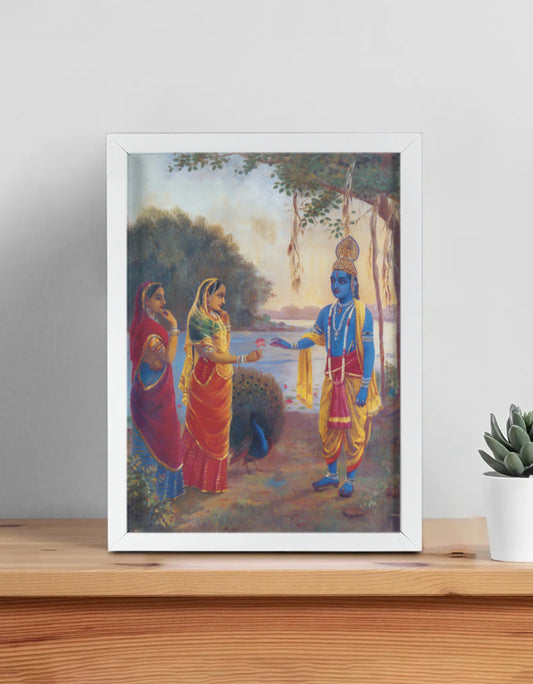
A young woman walks towards the man she loves, and her courage almost fails her. A trusted friend stays close at her side. In her hand is a single lotus, and over them spreads a great banyan tree on the bank of a river. That is the whole scene of Raja Ravi Varma's Radha and Krishna, painted in 1901, and it is enough to hold your gaze for a long time.
By 1901 Ravi Varma had been painting for more than three decades, much of that time learning to paint gods as if they were people you might meet. Here he takes the best-loved romance in Indian devotion and slows it to a single breath: the moment just before the gift is given. It is a quiet picture from a painter whose work is often linked with melodrama, and that quietness is exactly why it rewards a closer look.
Who are Radha and Krishna?
Krishna is worshipped as the eighth avatar of Vishnu, and also as a supreme god in his own right. Born to Vasudeva and Devaki, he was secretly carried to Gokula and raised by the cowherd chief Nanda and his wife Yashoda. As a youth he became known as a lover. The sound of his flute drew the gopis, the cowherd women, to dance with him in the moonlight, and his favourite among them was Radha.
Radha was a gopi of Vrindavan. In many tellings she was married to another cowherd, yet she remained Krishna's dearest companion. Her name appears as early as the Gatha Saptasati, a collection of Prakrit verses dated to around the first or second century AD, but her first major appearance comes in Jayadeva's twelfth-century Sanskrit poem, the Gita Govinda. That poem follows the lovers through attraction, estrangement, longing and, at last, reunion, helped along by a sakhi, a female confidant.
In the bhakti, or devotional, tradition, Radha is sometimes read as the human soul and Krishna as God, and their play together as the loving interplay between the two. So a painting of Radha coming shyly to Krishna is never only a love scene. It is also a picture of devotion itself.
Reading the painting
The lotus in her hand
Radha approaches Krishna holding a lotus. In Hindu iconography the lotus stands for what is divine or immortal in a human being, and across Indian traditions its clean bloom rising out of mud has carried a spiritual promise. Vishnu and Lakshmi are very often shown on a pink lotus. Placed in Radha's hands, the flower becomes the offering of a pure heart; one reading of this canvas sees it as her pledge of undying devotion.
The banyan tree
The tree spreading over the lovers is a banyan. It is India's national tree, it is considered sacred, and temples are often built near it. The banyan is also called Kalpavriksha or Kalpataru, the wish-fulfilling tree, because it provides so generously for human needs. Seen this way, Radha has chosen her ground with care. She stands beneath the tree of wishes, hoping hers will be granted.
The friend at her side
Radha does not come alone. A trusted companion walks with her, and this figure has deep roots. In the Gita Govinda it is a sakhi who helps bring the estranged lovers back together. Ravi Varma keeps her close beside Radha, the go-between of the old poems brought into a real landscape.
Radha's shyness
The feeling the whole picture is built around is hesitation. Radha comes forward, but shyly. Ravi Varma often modelled his goddesses on Indian women he thought beautiful, and he gives Radha the bearing of a real young woman rather than a distant icon. That very human pause is what makes the scene feel so close.
The riverbank
Painters inspired by the Gita Govinda, especially in the Rajasthani and Pahari courts, liked to show Radha waiting for Krishna at twilight or meeting him in a forest grove. Ravi Varma also takes the lovers outdoors, setting the meeting on the bank of a river, with the banyan for shelter.
The artist
Raja Ravi Varma was born on 29 April 1848 at Kilimanoor Palace, near Trivandrum, in the princely state of Travancore, in present-day Kerala. His uncle, the painter Raja Raja Varma, noticed the boy drawing on the palace walls and gave him his first lessons. When he was 14, Maharaja Ayilyam Thirunal of Travancore became his patron. He trained in watercolour with Rama Swami Naidu, and three years after the Maharaja took him up he began studying oil painting with Theodore Jensen, a Danish-born British artist.
He became one of the first Indian artists to work in oils, and his reputation travelled far beyond Travancore. He won an award at an exhibition in Vienna in 1873 and three gold medals at the World's Columbian Exposition in Chicago in 1893. In 1904 the Viceroy, Lord Curzon, presented him with the Kaisar-i-Hind Gold Medal.
His great achievement was to marry Hindu mythology to European realism. He painted portraits of Indians and Britons alike, but turned more and more to the epics and Puranas, bringing the polish of a European academic studio to Indian gods and heroines. Works such as Shakuntala, The Milkmaid and Expectation show the grace he became famous for.
He died on 2 October 1906. Sources disagree on where: one major encyclopedia places his death at Kilimanoor Palace, while other accounts name Attingal, also in Travancore. Diabetes and grief at his brother's death are said to have contributed.
The history of this image
Radha and Krishna was painted in oil on canvas in 1901, in Travancore, in the last years of the artist's life. It belongs to a moment when Ravi Varma's name was everywhere, largely because of prints.
As early as 1884, T. Madhava Rao, a former Diwan of Travancore, had urged him to have his paintings reproduced as oleographs. In 1894 Ravi Varma and his brother Raja Raja Varma opened the Ravi Varma Fine Arts Lithographic Press in Bombay. Most detailed accounts place it first in Girgaum, with a move to Ghatkopar in 1898 after plague broke out, though some sources say it began in Ghatkopar. Its first oleograph, The Birth of Shakuntala, was printed on 12 July 1894 and sold for Rs 6; Lakshmi and Saraswati followed at Rs 2 each. A single image could need anywhere from seven to thirty litho stones, colour laid over colour until the shade was right.
The press brought fame but not profit. The brothers sold it to the German technician Fritz Schleicher for Rs 25,000, though the year is disputed: several sources give 1901, the same year this painting was made, while one detailed account gives 1903. Schleicher took copyright permission for over a hundred paintings and kept printing them. The press also moved to Malavli, near Lonavala, though that move is dated variously to 1899 or 1901. After the takeover, print quality reportedly declined and prints carrying Ravi Varma's signature, but not his designs, multiplied. The press was later destroyed by fire, in 1972 according to most accounts and 1973 according to one.
Why it endured
Ravi Varma's images, spread through those prints, helped create a shared, pan-Indian picture of the gods at a time of cultural fragmentation. Affordable oleographs carried scenes from the epics and Puranas out of temples and palaces into ordinary homes, from village huts to mansions. In Tamil Nadu, women dressed the printed figures in silks and embroidery, and Chettiar merchants took the prints as far as Burma.
Critics have not always been kind. Some dismissed his work as "calendar art", and others called it kitsch. Yet interest in his paintings has never faded, and the art historian Geeta Kapur has called him "the indisputable father figure of modern Indian art". The scholar Christopher Pinney has noted that his reputation carries two opposing images at once: the patriarch of high art and the maker of inexpensive prints.
The story he chose here has endured just as stubbornly. The Gita Govinda inspired centuries of painting and poetry about Radha and Krishna, and its songs are still sung in temples, at festivals and in kirtans. In Kerala, Ravi Varma's own home, musicians adapted its verses into the temple music called sopana sangeetham. A painting that catches Radha in her most tender moment speaks to all of that at once.
About this print
The original is an oil painting on canvas by Raja Ravi Varma, dated 1901 and made in Travancore. It measures about 60 × 70 cm (23.6 × 27.6 inches). Our print is a digitally restored reproduction of that painting, made for framing and display at home.
How we restored it
Our restoration is entirely digital. We cleaned away stains, specks and surface damage visible in the source image, reduced grain and noise, and sharpened fine detail in faces, fabric and foliage. We then corrected the colour carefully against the source, so the tones stay faithful to Ravi Varma's palette rather than drifting brighter or cooler. Some of this work uses AI-assisted tools, but every step is checked by eye. Nothing has been repainted, and no physical conservation was involved.
Bringing it home
- Living room: a warm, story-rich centrepiece above a sofa or console
- Puja room or quiet corner: a gentle image of devotion for daily prayer or reflection
- Bedroom: a tender love story for a couple's room
- Weddings and anniversaries: a timeless symbol of devoted love
- Janmashtami and Diwali: a meaningful festive gift
- Housewarmings and return gifts: a thoughtful piece of Indian heritage
Quick facts
- Title: Radha and Krishna
- Artist: Raja Ravi Varma (1848–1906)
- Date: 1901
- Medium of original: Oil on canvas
- Size of original: about 60 × 70 cm (23.6 × 27.6 in)
- Made in: Travancore (present-day Kerala)
- Style: Academic art
- Subjects: Radha, Krishna and Radha's companion
- Key symbols: Lotus, banyan tree, riverbank
- This print: Digitally restored reproduction




Join the conversation
Comments
What does this painting mean to you?
Log in to join the conversation
No password needed. We email you a one-time code.
Awaiting approval
No comments yet. Be the first to share your thoughts.