The first sight of the West
In June 1871, a young illustrator from Philadelphia boarded a train heading west. He had been asked to picture a strange region called Yellowstone, rumoured to be full of geysers, boiling springs and bubbling mud. But before he reached it, Thomas Moran stepped off at Green River, a railway stop in Wyoming Territory, and saw a landscape unlike anything he had known. Towering cliffs of banded rock rose above the dusty town. He made a small study on the spot and later inscribed it "First Sketch Made in the West."
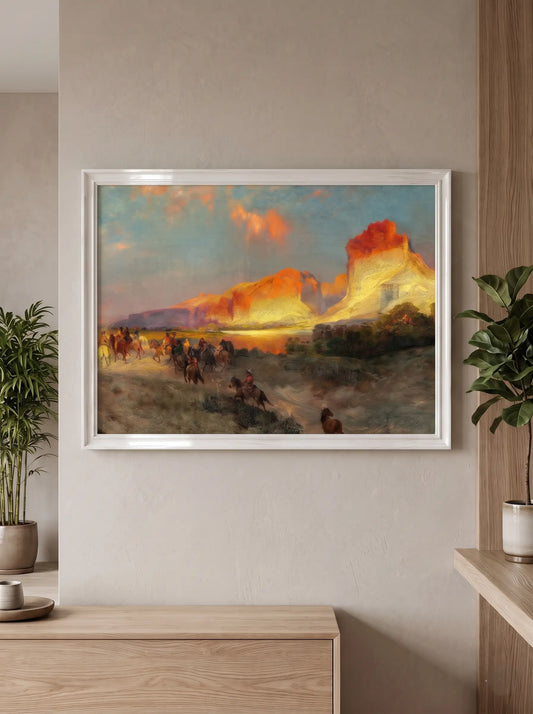
Ten years later, in 1881, he turned that memory into this wide, luminous canvas: sheer cliffs lit cream and rust by a low sun, and a line of riders crossing the ground beneath them. Look for the town, the bridge, the railway that carried him there. You will not find them. Moran left them out on purpose, and that choice is the key to the whole painting.
The place: Green River
The town of Green River was laid out by the Union Pacific Railroad in 1867 and incorporated in August 1868, the year the tracks arrived. The railway crews' tent camp grew fast into a boomtown with a schoolhouse, hotel, church and brewery. One account puts its population at about 2,000 in 1868. A year later, in May 1869, the explorer John Wesley Powell launched his famous river expedition from here.
Above the town stand the cliffs: sandstone carved by centuries of wind and water into buttes and towers. The rocks of this region give their name to the Green River Formation, laid down in a chain of ancient lakes roughly 50 million years ago in fine alternating light and dark layers. Those layers, worn open, are the bands of colour that captivated Moran.
Reading the painting
The cliffs
The cliffs are the real subject. Moran stretched the composition into a long horizontal so that they march across the canvas like a fortress wall. Their stripes of cream, ochre and rust are not decoration; they are the geology itself, simplified and heightened. Moran had studied the British painter J. M. W. Turner, and you can feel that lesson in how colour and atmosphere do the work that outline might have done.
The caravan
Below the cliffs, a band of American Indian riders moves across the foreground. The curator Nancy Anderson described it as "an Indian caravan winding its way toward a distant village." Moran reshaped the foreground into a stage for them. Their small size is the point: they make the cliffs feel immense.
The light
The sun is low. Anderson noted how dramatic plays of light and shadow guide the eye toward the setting sun, so that the picture reads from left to right like a journey ending at dusk. The glow on the rock faces is what makes the scene feel like a vision rather than a survey drawing.
What is missing
This is the most important detail, because it is an absence. In 1881 Green River was a working railway town, yet no buildings, tracks or bridge appear. Moran conjured instead a pre-industrial West that neither he nor anyone else could have seen in 1871, the wilderness his Eastern buyers imagined. He was candid about it. "I place no value upon literal transcripts from Nature," he once admitted, explaining that his tendencies were all toward idealisation.
The signature
Lower right sits Moran's signature and the date, 1881. After Yellowstone made his name, he adopted a monogram of the letters T, Y and M, for Thomas "Yellowstone" Moran. Descriptions of this canvas differ slightly: one sale catalogue reads the signature simply as "TMoran," while other records describe the T-Y-M monogram.
The artist
Thomas Moran was born on 12 February 1837 in Bolton, Lancashire, in England, into a family of handloom weavers. They emigrated to the United States in 1844, when he was seven, settling first in Baltimore and then in Kensington, near Philadelphia. As a teenager he was apprenticed to a Philadelphia wood-engraving firm, found the work tedious, and spent his free hours on watercolours. In 1862 he travelled to England to see Turner's paintings at first hand.
He became an illustrator for Scribner's Monthly, and in 1871 the financier Jay Cooke recommended him to the geologist Ferdinand V. Hayden as "an artist of Philadelphia of rare genius." Moran joined Hayden's survey of Yellowstone and, in roughly forty days in the field (one account says five weeks), recorded more than 30 sites. His sketches, alongside William Henry Jackson's photographs, helped persuade Congress to create Yellowstone as the first national park in 1872. That same year the government bought his huge The Grand Canyon of the Yellowstone for $10,000.
Between 1871 and 1892 he made eight journeys west. He was elected to the National Academy of Design in 1884, served as president of New York's Salmagundi Club, and worked from a home in East Hampton, New York. His wife, Mary Nimmo Moran, was a noted etcher. He later moved to Santa Barbara, California, where he died on 25 August 1926.
The history of this painting
Green River was the subject Moran returned to again and again. His sketch lived in his studio as the basis for dozens of later works, and sources count them differently: one account gives more than 40 depictions of the river's bluffs, while Joni Kinsey's study of Moran counts more than a hundred once etchings, engravings, chromolithographs and sketches are included. His daughter Ruth remembered that whenever the household needed money, the family joked it was time for Father to paint another Green River.
He also went back in person, including in 1881 itself, when he made a detour to Green River on his way home after a long year of travel. This canvas was finished that year and shown at the Inter-State Industrial Exposition in Chicago in 1881. According to the 1994 sale catalogue, Moran painted five large versions of this particular view with its imposing butte, and this is the most ambitious; the same catalogue notes that L. Prang & Co. published a lithograph of the subject that year.
The painting later passed to Frederick W. Allsopp of Little Rock, who gave it in 1937 to the city's art museum, where it stayed until 1983. It was shown in the 1991 exhibition The West as America, which re-examined images of the frontier, sold at auction in New York in 1994 for $2.7 million, and appeared in the first major Moran retrospective in 1997–98. Nancy Anderson, who organised that show, called it "one of the stars of the show."
Why it endured
Moran's fame was built on Yellowstone, but many now consider his Green River paintings his best, and this one the most celebrated of them. Part of its power is simple beauty: colour, scale and light that still stop a viewer.
Part of it is honesty of a different kind. The painting is an openly invented West, and that makes it a document of its age. It shows what nineteenth-century Americans wanted the frontier to be: ancient, untouched and vast, with the railway that was transforming it quietly painted out. Looking at it today means holding both truths at once, the grandeur of the land and the story the picture chose not to tell.
About this print
The original is an oil painting on canvas by Thomas Moran, signed and dated 1881. It measures about 63.5 × 157.5 cm (25 × 62 in), a long panoramic format; the 1994 sale catalogue gave slightly different measurements, about 64.8 × 158 cm.
How we restored it
We restored this image digitally, working from a high-resolution reproduction of the painting. We cleaned away stains, specks and surface damage, reduced grain and noise, and sharpened fine detail in the rock faces and the riders. We then corrected the colour carefully against the source so the cliffs keep their cream, ochre and rust glow. Some steps used AI-assisted tools, and every change was checked by eye. Nothing was repainted, and no physical conservation was involved: this is a faithful digital restoration of Moran's picture.
Bringing it home
- Living room: its long, wide format suits a sofa wall or a low console.
- Study or home office: a calm, expansive view to rest the eyes.
- Hallway or landing: a panorama that rewards a passing glance.
- For travellers and hikers: a gift for anyone who loves wild landscapes and national parks.
- For geology or history lovers: banded rock and a story of the American frontier.
- Housewarming or retirement: a picture about journeys, arrivals and new horizons.
Quick facts
- Title: Green River Cliffs, Wyoming
- Artist: Thomas Moran (1837–1926)
- Date: 1881
- Medium: Oil on canvas
- Size of original: about 63.5 × 157.5 cm (25 × 62 in)
- Subject: The banded sandstone cliffs at Green River, Wyoming, with a caravan of American Indian riders
- Style: American Western landscape
- First sketched: 1871, on Moran's first trip west
- First exhibited: Inter-State Industrial Exposition, Chicago, 1881
- Signature: Lower right, dated 1881




Join the conversation
Comments
What does this painting mean to you?
Log in to join the conversation
No password needed. We email you a one-time code.
Awaiting approval
No comments yet. Be the first to share your thoughts.